

Volatility is one of the most important slot concepts, but also one of the easiest to misunderstand.
In simple terms, volatility describeshow a slot tends to distribute payouts. A lower-volatility slot usually spreads returns more evenly through smaller, more frequent results. A higher-volatility slot usually concentrates more value into fewer, larger outcomes.
This doesnotmean one type is always better. It means the slot may feel very different from one session to another depending on how its payout structure is built.
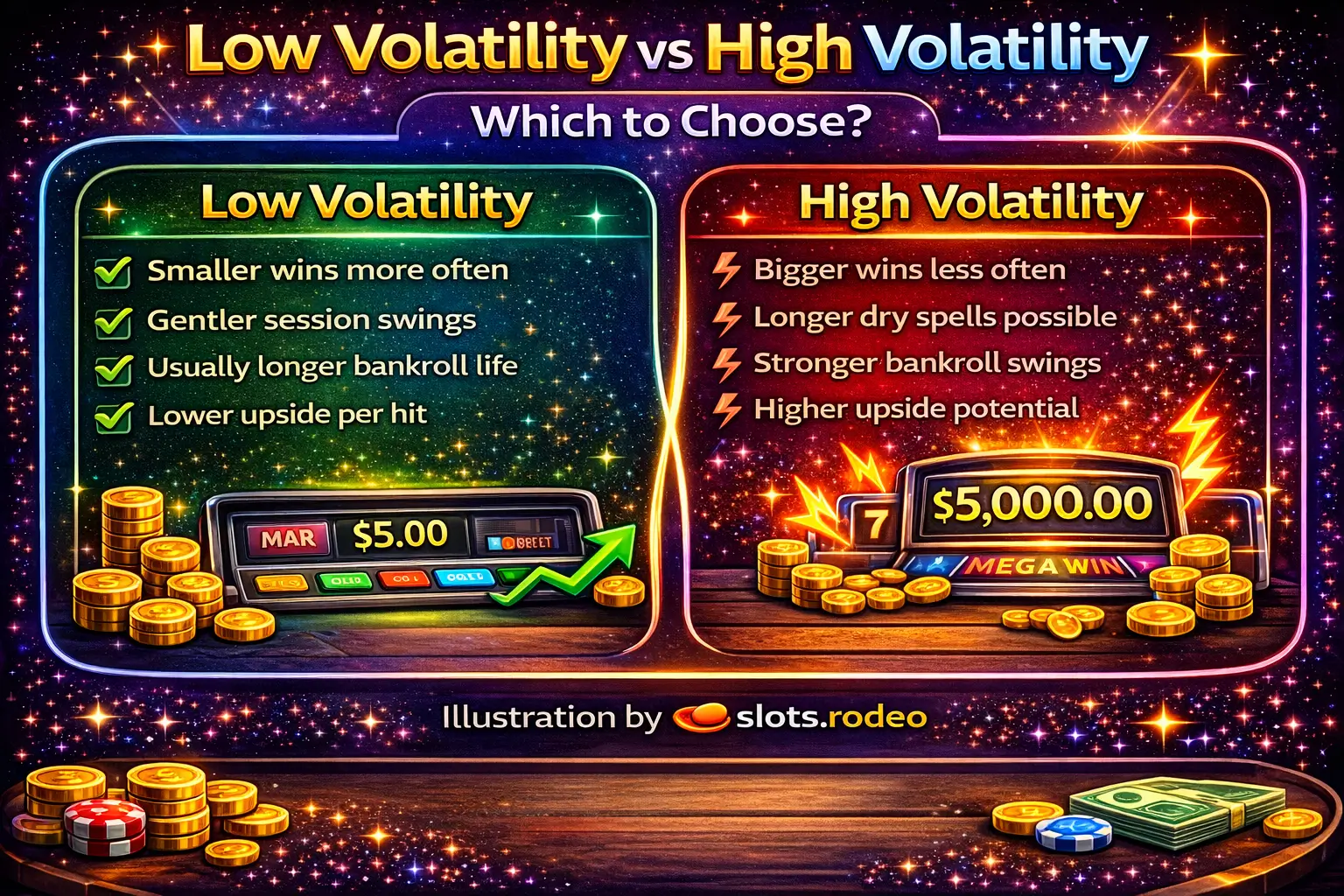
What volatility means in simple terms
Volatility is aboutpayout distributionnot just payout size.
A lower-volatility slot usually aims to return value in a smoother way. That often means:
- more frequent smaller wins
- shorter dry stretches
- less value concentrated in rare top-end outcomes
A higher-volatility slot usually places more value into less frequent, stronger results. That often means:
- longer losing stretches
- fewer meaningful hits
- more dependence on bonus rounds, multipliers, or larger feature outcomes
This is why volatility often shapes thefeelof a session more directly than RTP.
Low volatility and high volatility are not value judgments
A common mistake is to read volatility like a quality label.
That is wrong.
- Low volatilitydoes not mean weak
- High volatilitydoes not mean better
- Medium volatilitydoes not automatically mean balanced in every practical sense
Volatility is a structural description. It helps explainhowthe slot may return value, not whether the slot is "good" or "bad."
The core difference at a glance
| Feature | Low Volatility | High Volatility |
|---|---|---|
| Win frequency | Often more frequent | Often less frequent |
| Typical win size | Usually smaller | Often more uneven, with stronger peaks |
| Dry spells | Usually shorter | Often longer |
| Session feel | Smoother | Sharper and more swing-heavy |
| Value concentration | More spread out | More concentrated in fewer outcomes |
| Bonus dependence | Often lower or more moderate | Often higher |
Win frequency
Typical win size
Dry spells
Session feel
Value concentration
Bonus dependence
This is the broad pattern. Real slots can vary, but this table explains the usual logic.
What low-volatility slots usually feel like
A lower-volatility slot often feels more active during ordinary play.
You may notice:
- more visible wins
- fewer long empty stretches
- smaller returns that keep appearing
- less dependence on one major hit
This doesnotmean the slot is generous in a strong practical sense. Many of those wins may still be smaller than the total bet. It means the slot often spreads more activity across the session.
For some players, this feels easier to follow because the game stays more visibly engaged.
What high-volatility slots usually feel like
A higher-volatility slot often feels less even.
You may notice:
- many spins with no meaningful return
- longer quiet periods
- more importance placed on free spins or feature triggers
- bigger jumps when strong outcomes do happen
This is why high-volatility slots are often described as more "swingy." A large part of the slot's visible value may be tied to fewer moments.
That can make the session feel more dramatic, but also more uneven.
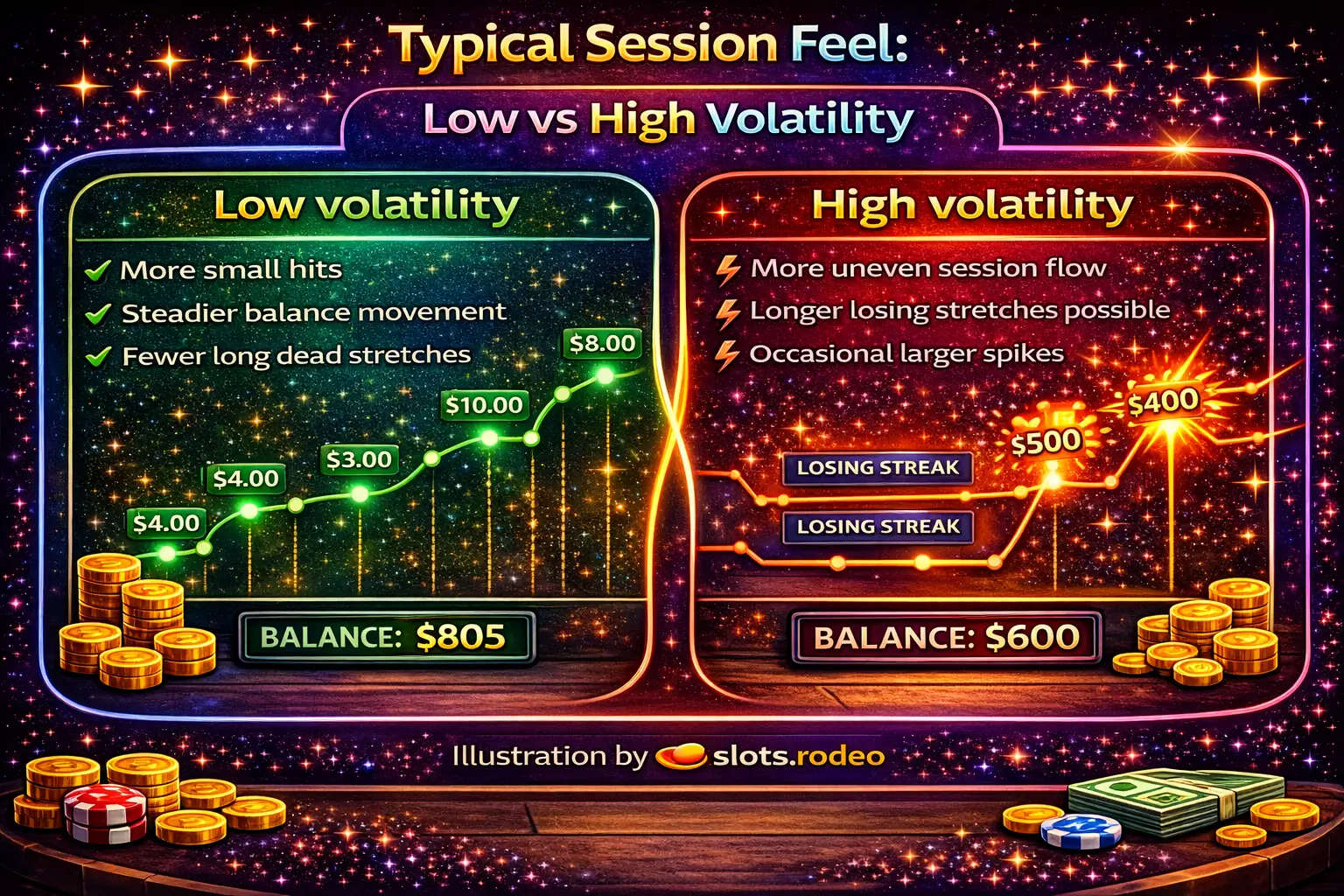
Volatility changes session feel more than many beginners expect
Two slots can have the same RTP and still feel completely different because of volatility.
For example:
| Slot | RTP | Volatility | Possible session feel |
|---|---|---|---|
| Slot A | 96.0% | Low | More frequent smaller returns |
| Slot B | 96.0% | High | Longer dry periods, more top-heavy |
Slot A
Slot B
This is one of the most important points in slot comparison.
The long-term theoretical return may be similar, but thepathto that return can be very different.
Low volatility may suit players who want a steadier rhythm
A lower-volatility slot may suit players who prefer:
- more regular visible wins
- less dramatic balance movement
- a clearer sense of base-game activity
- fewer long quiet stretches
This does not imply that the slot is devoid of risk. It indicates that the return behavior might appear more consistent and simpler to follow during brief gameplay.
For newcomers, slots with lower volatility are generally easier to interpret due to their typically less intense session rhythms.
High volatility might appeal to players who are willing to endure a more tumultuous experience.
A higher-volatility slot could attract players who are particularly interested in:
- greater maximum win potential
- more pronounced differences between regular and bonus gameplay
- a higher frequency of significant payout moments
- designs that emphasize bonuses
However, this structure often comes with certain compromises:
- prolonged periods without wins
- increased reliance on infrequent occurrences
- fewer substantial wins during certain phases of the gameplay session
Thus, the decision is not about which type is universally superior. It revolves around which payout pattern aligns with the type of session you wish to assess.

Low volatility does not equate to low returns.
This is a crucial clarification.
A low-volatility slot is not inherently a low-return slot; it simply distributes value differently.
Similarly, a high-volatility slot does not guarantee greater overall rewards; it may merely concentrate more value into fewer occurrences.
This is why volatility should never be evaluated independently of:
- RTP
- hit frequency
- feature layout
- max win
- the slot's distribution of value
High volatility does not automatically translate to larger wins in reality.
A higher-volatility slot tends to focus more on top-end payouts, but that doesn’t imply that every brief session will clearly demonstrate this.
In practical terms, a player might experience:
- extended periods of inactivity
- subpar bonuses
- minimal visible returns in a short timeframe
The significant upside is part of the design, but it may not manifest quickly during a session.
This is why high-volatility slots are frequently misunderstood. Players recognize the potential maximum, but often overlook the cost associated with pursuing it.
The base game experience often differs between low and high volatility slots.
This represents one of the most distinct practical contrasts.
A low-volatility base game usually features:
- more frequent small wins
- more consistent gameplay movement
- less dependence on a single feature outcome
High-volatility base games typically appear as:
- quieter spinning reels
- more non-winning spins
- greater reliance on bonus entry or multiplier occurrences
This is why players frequently refer to high-volatility slots as "feature-driven."
In high-volatility slots, bonus features often hold more significance
In numerous higher-volatility slots, a substantial portion of the game's value resides in:
- free spins
- multiplier features
- expanding symbol occurrences
- stacked wild results
- rare bonus combinations
This does not imply that low-volatility slots lack features. It indicates theimportanceimpact of those features is generally more pronounced in higher-volatility designs.
When a slot relies heavily on feature access, that factor typically outweighs the volatility classification alone.
Which option should a novice select?
For many newcomers, lower-volatility slots are more straightforward and less perplexing during brief play sessions.
Factors include:
- more noticeable action
- shorter periods without wins
- easier-to-follow session dynamics
- less reliance on a single rare feature occurrence
Nevertheless, the optimal choice still hinges on what the player aims to grasp.
If the objective is to learn how slots operate in a more transparent, comprehensible manner, lower-volatility structures are generally more straightforward to analyze.
If the aim is to comprehend bonus-rich, high-stakes slot design, higher-volatility slots can illustrate that effectively as well, though they often feel less balanced.
The more pertinent question is not "which is superior?" but "superior for what purpose?"
This offers the most practical perspective on the choice.
| Question | Lower Volatility Often Fits Better | Higher Volatility Often Fits Better |
|---|---|---|
| Desire a more consistent session rhythm? | Yes | Less often |
| Prefer fewer extended dry spells? | Yes | Less often |
| Seek greater top-end concentration? | Less often | Yes |
| Yearn for a more bonus-centric experience? | Sometimes | More often |
| Need a clearer, simpler short-session read? | Yes | Less often |
Desire a more consistent session rhythm?
Looking to avoid prolonged dry spells?
Seeking greater high-end concentration?
Desiring a more bonus-rich experience?
Want a straightforward short-session assessment?
This offers a much clearer comparison than attempting to prioritize one type over another.
Common misguided reasons for selecting a slot based on volatility
Players frequently make suboptimal choices due to flawed reasoning such as:
- "high volatility equates to better payouts"
- "low volatility indicates safety"
- "high volatility is meant for serious gamers"
- "low volatility is unexciting"
- "a single strong session validates the classification"
These notions are overly simplistic and often inaccurate.
Volatility should aid in comprehending the payout pattern, not serve as a shortcut for status or quality.
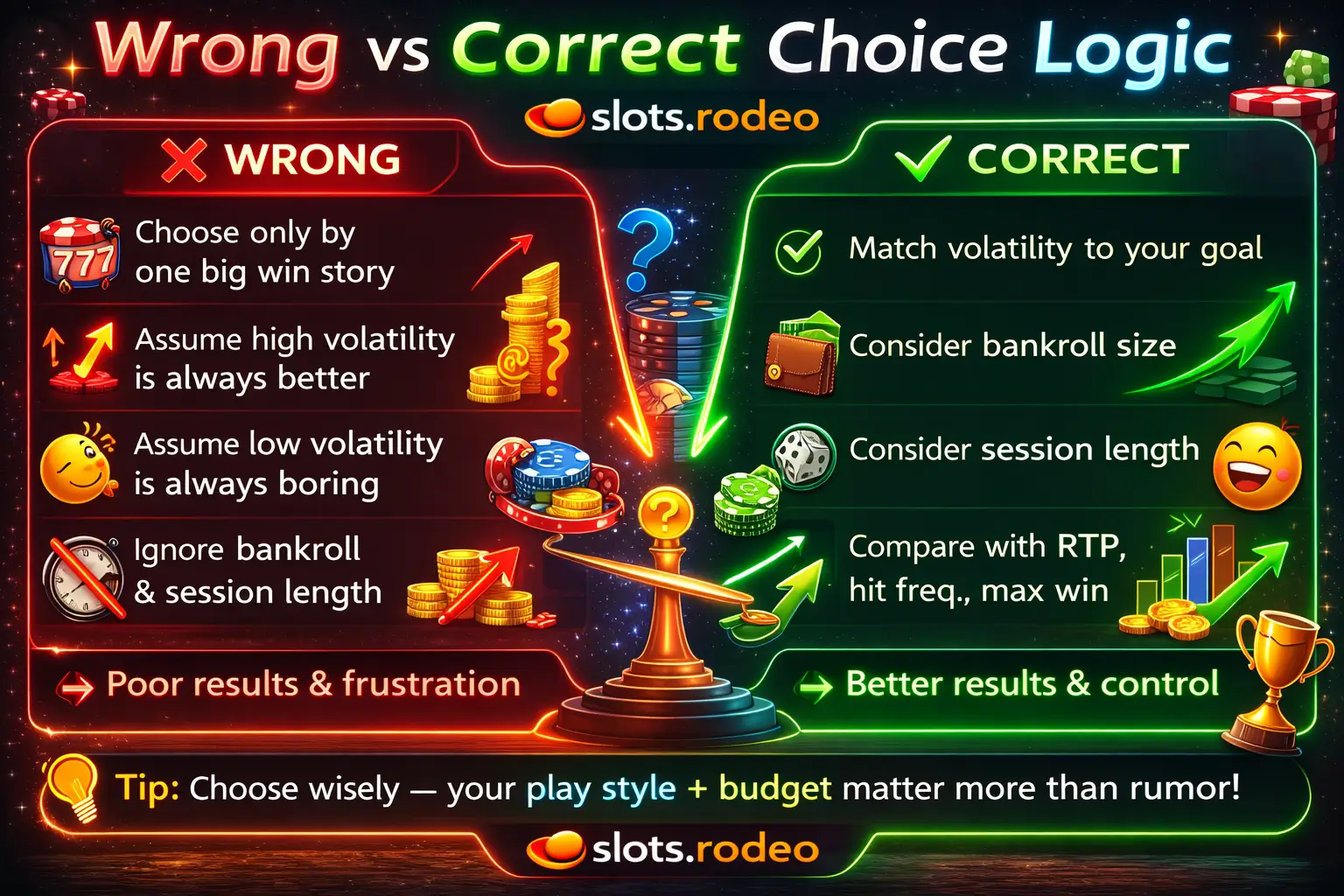
What volatility fails to reveal
Volatility is significant, yet limited.
It doesnottell you:
- the precise RTP
- how frequently the bonus activates
- the size of the average payout
- the maximum potential win
- the configuration of the paytable
- whether the slot utilizes paylines, ways, or clusters
- the likelihood of a short session performing well or poorly
That is why volatility should always be analyzed alongside the entire slot profile.
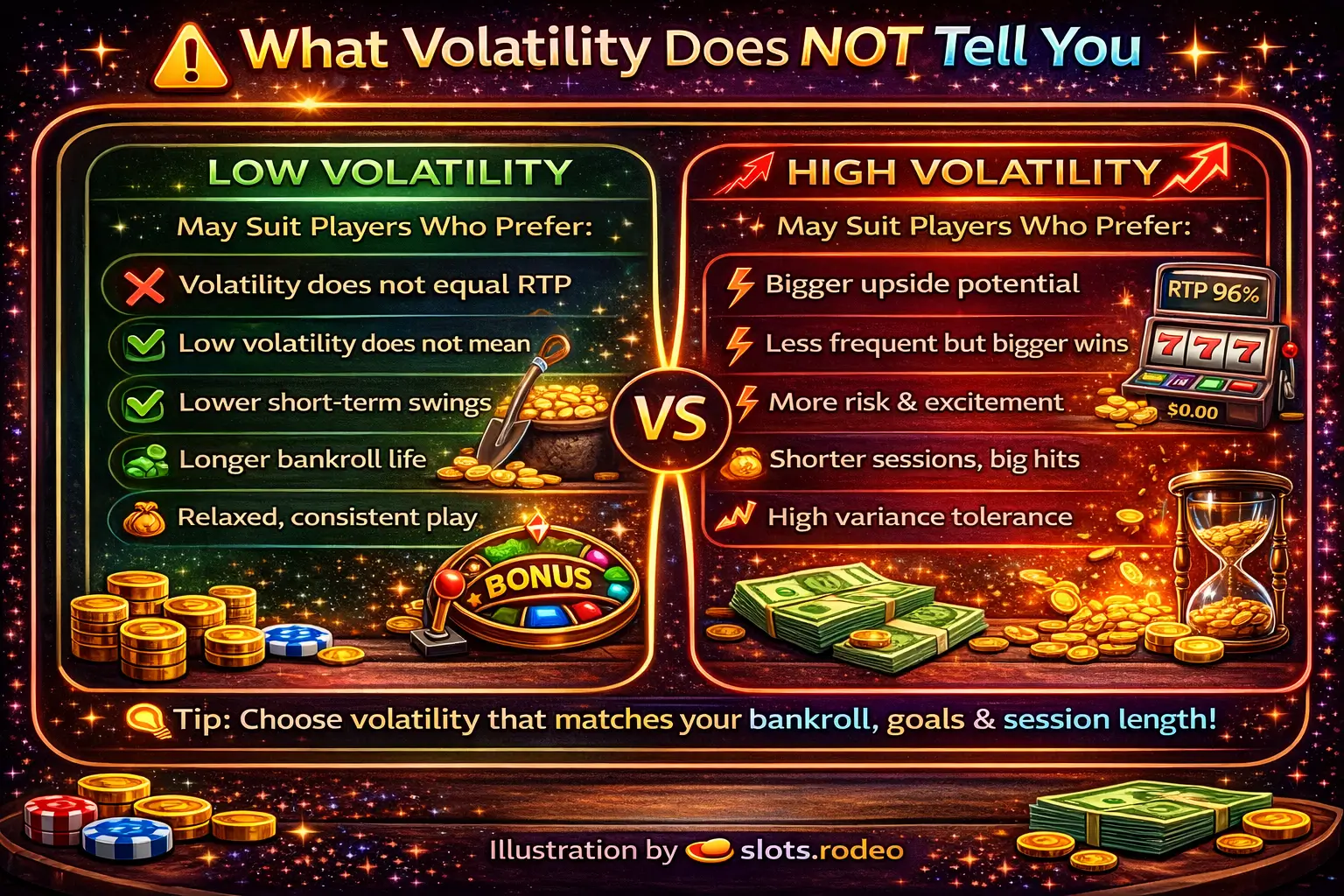
Low volatility versus high volatility in a practical context
An effective comparison should consider:
- How dynamic does the base game appear?
- Does the slot depend significantly on free spins or key features?
- Are wins generally small but frequent, or are they less common and more substantial?
- Does the gameplay feel fluid or abrupt?
- Is the maximum potential win likely to be significantly higher than typical gameplay?
These inquiries are more insightful than simply ranking volatility.
Frequent mistakes made by newcomers
Assuming low volatility guarantees consistent comfort
While it may seem smoother, it can still lead to numerous losses or minimal returns.
Believing high volatility equates to guaranteed large payouts
It usually signifies a greater focus on high-end wins, not assured strong results in brief sessions.
Considering volatility without verifying RTP
The payout trends and long-term returns are distinct aspects.
Overlooking feature reliance
Certain slots derive much of their value from bonus features, irrespective of their categorization.
Interpreting one brief session as conclusive evidence
A short experience cannot adequately represent the overall volatility pattern.
What to evaluate before making a choice between them
Prior to determining if a lower- or higher-volatility slot is more suitable, consider these factors:
| What to check | Why it matters |
|---|---|
| RTP | Long-term return still matters |
| Bonus arrangement | Shows how feature-dependent the slot is |
| Win system | Helps explain how the slot feels spin by spin |
| Max win | Shows whether the game has a modest or large ceiling |
| Hit rhythm | Helps explain how active the session may feel |
| Base game versus feature equilibrium | Important for understanding how the value is distributed |
RTP
Bonus arrangement
Win system
Max win
Hit rhythm
Base game versus feature equilibrium
FAQ
Frequently asked questions regarding this subject.
Low volatility typically results in a more uniform distribution of returns. Conversely, high volatility tends to focus value into fewer, more substantial wins.
Often, yes, as the gameplay generally feels more fluid and easier to interpret.
No. RTP and volatility represent distinct measurements.
No. While they may exhibit a stronger concentration at the high end, this doesn't guarantee improved results for shorter sessions.
The optimal choice is contingent on whether you prefer a more consistent session experience or a payout structure that favors larger wins.
