

Two slots may appear almost identical on paper yet perform quite differently during play.
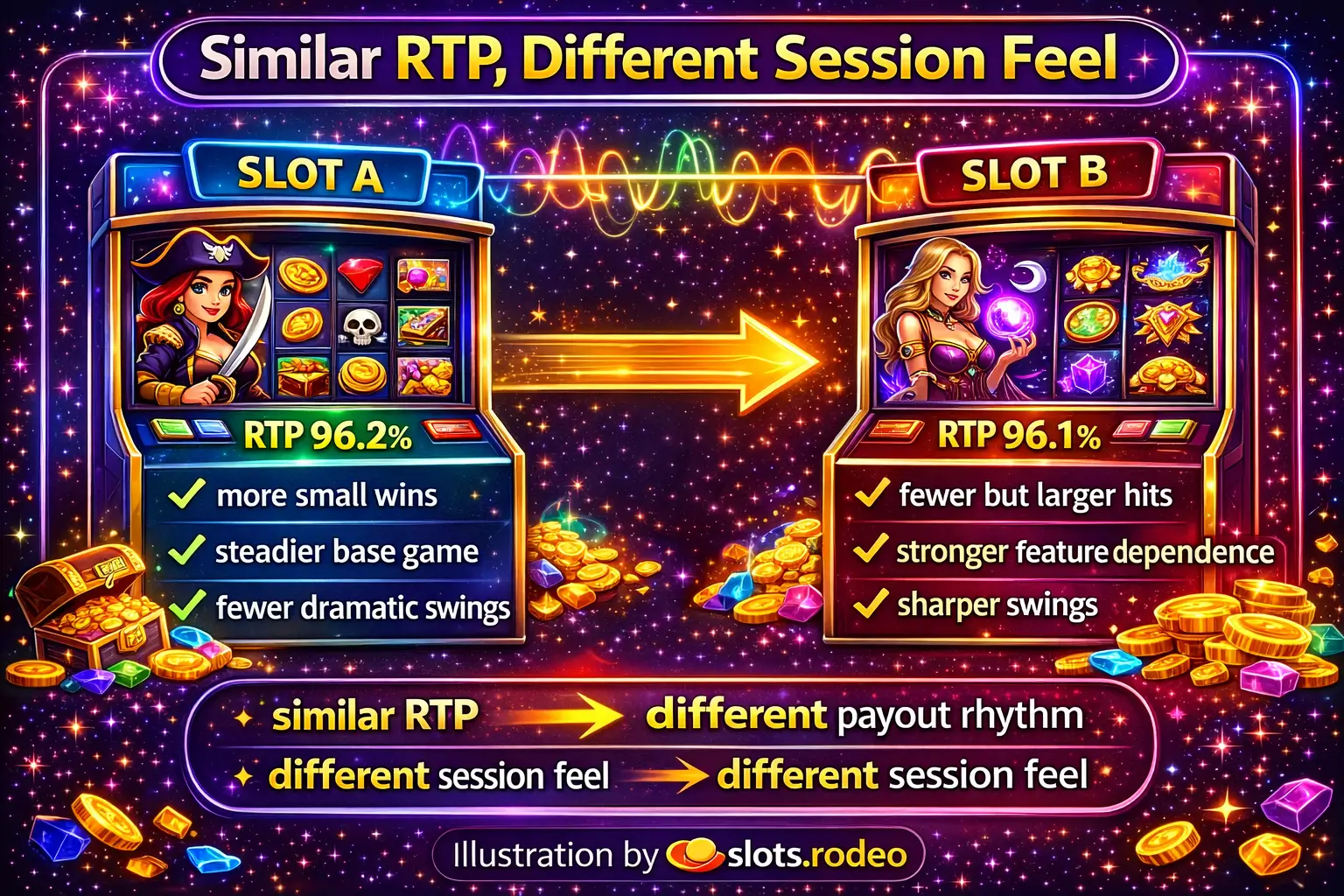
A game with an RTP of 96.10% versus another at 96.00% might seem similar in terms of returns, but that doesnotnot guarantee they will produce the same session experience. One could offer more frequent smaller payouts, while the other might have longer intervals between wins, with a stronger focus on bonus rounds or larger payouts.
This variance stems from the slot's value distribution rather than RTP alone.
RTP indicates the long-term return but does not reflect the experience during gameplay.
RTP is a theoretical figure that represents the expected return of a slot over a significant number of spins.
What RTP revealsnoton its own:
- the frequency of wins
- the average size of wins
- the proportion of returns from the base game compared to bonus features
- the potential duration of dry spells
- the level of balance pressure a player might experience
This is why two slots with similar RTP can evoke entirely different feelings during play.
A close RTP figure does not imply congruent session behavior.
An RTP difference of 0.10% or 0.20% is minimal when compared to the impact of volatility and payout design.
For instance:
| Slot | RTP | Typical pattern |
|---|---|---|
| Slot A | 96.1% | More frequent small wins, steadier balance movement |
| Slot B | 96.0% | Longer quiet stretches, more value tied to feature rounds |
Slot A
Slot B
These are not merely forecasts for a single session. They indicate thatreturn percentageandreturn distributionare distinct concepts.
What influences the overall feel of a slot beyond RTP
The mechanics of a slot are typically guided by a series of interconnected design decisions.
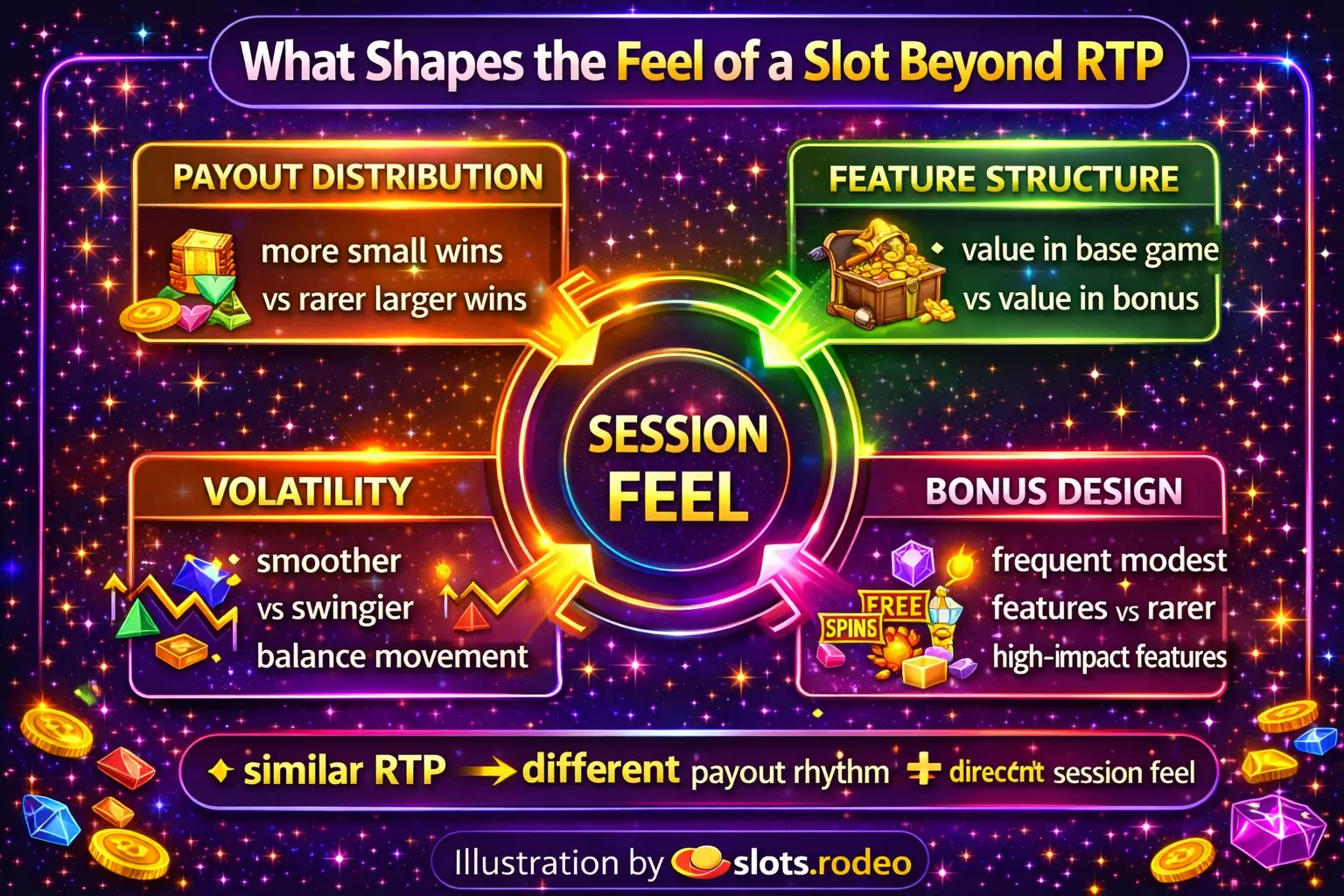
Volatility
Volatility determines how payout values are allocated over time.
A slot with lower volatility generally yields more frequent payouts with smaller fluctuations, whereas a higher-volatility slot may deliver less frequent wins but with greater potential for larger payouts.
This is a primary reason why games with comparable RTP can present such different experiences.
Payout distribution
Certain slots distribute a greater portion of their returns during the base game, while others allocate more value to free spins, multipliers, respins, or high-value combinations.
If a game focuses more value on rarer occurrences, it may feel slower or more inconsistent between those moments.
Feature structure
The design of bonuses alters the game's tempo.
A slot that triggers features frequently but with lower value can feel lively. In contrast, a slot with infrequent but high-impact features may feel stagnant for longer stretches, despite both games having similar RTP.
Win frequency and hit profile
Two slots might both achieve numerous 'winning spins,' yet that does not imply they will feel the same. A slot that frequently hits low-value wins returning less than the stake may create a different sensation than one with fewer but more substantial payouts.
Reel and symbol behavior
Mechanics such as Megaways layouts, cluster pays, cascading symbols, expanding symbols, sticky wilds, and progressive multipliers can all influence how wins accumulate. These features affect the rhythm of gameplay even when RTP values are alike.
The same RTP can be allocated in vastly different manners
Consider RTP as the cumulative return the game is designed to provide over time. The crucial question ishow that total is allocated.
| Return component | Slot style 1 | Slot style 2 |
|---|---|---|
| Base-game contribution | Higher share | Lower share |
| Contribution of bonus features | Lower share | Higher share |
| Small wins | More common | Less common |
| Significant fluctuations | Less pronounced | More pronounced |
| Overall session experience | Smoother | More uneven |
Contribution from the base game
Bonus feature contribution
Small wins
Significant fluctuations
Overall session experience
This is why "identical RTP" does not equate to "identical value distribution."
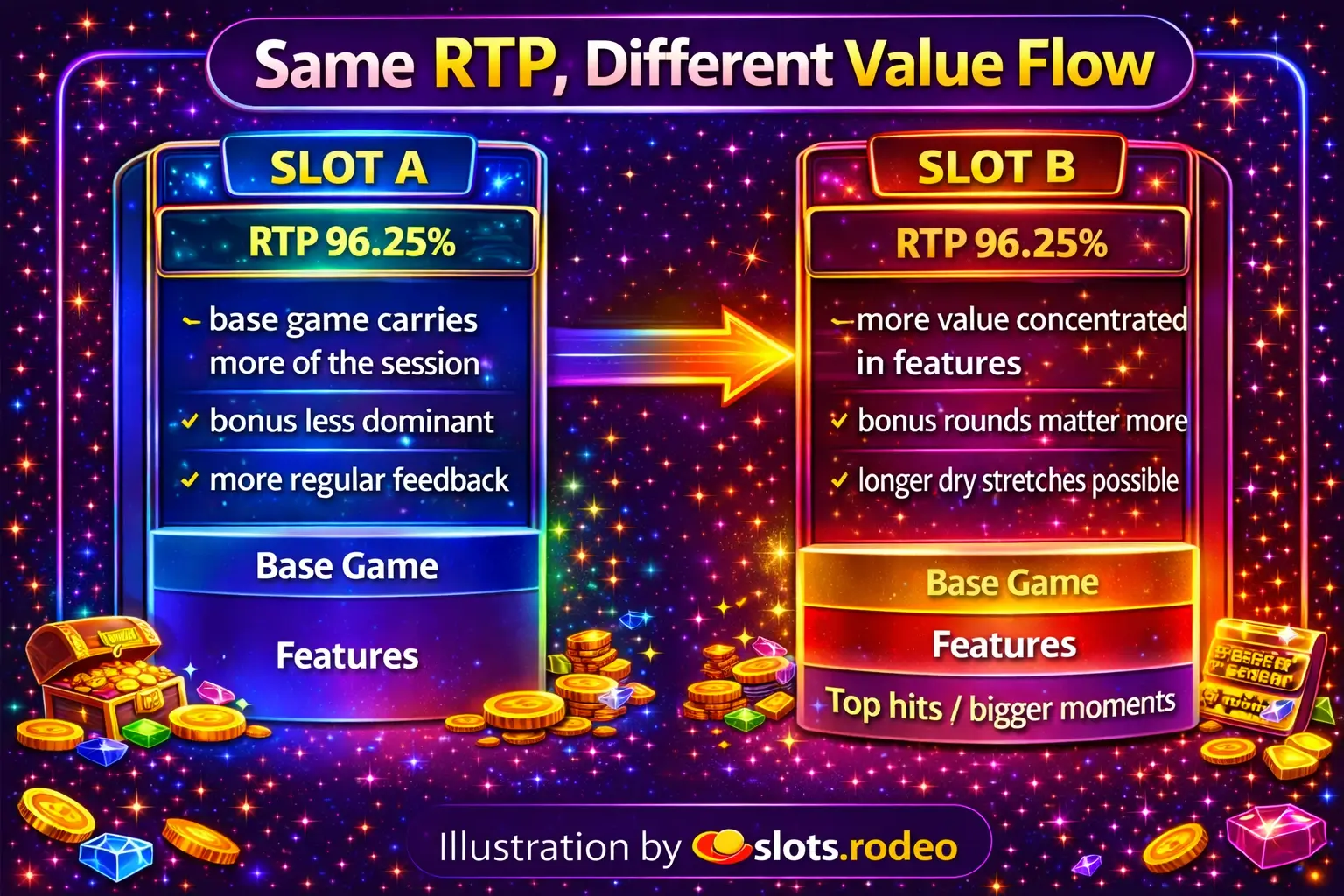
A slot providing more returns through consistent base-game wins may appear stable. Conversely, another slot with an identical RTP might conceal more value within bonus rounds, leading to a session that feels more prolonged and reliant on accessing features.
Reasons why feature-rich slots often present a different feel
Slots that are rich in features typically allocate a significant portion of their return through one or several bonus modes, influencing the overall gameplay dynamics.
A game designed this way might exhibit:
- prolonged periods where the base game offers little action
- an increased emphasis on activating free spins or other key features
- a more pronounced difference between regular spins and high-value moments
- more noticeable fluctuations in balance
Conversely, a slot that prioritizes the base game may feel less intense, yet more consistent.
Neither approach is inherently superior; they simply foster different gaming experiences.
Similar RTP, but varied impact on bankroll management
The feel of a session is closely linked to the pressure on the bankroll.
A slot that delivers returns in a more consistent manner may allow the balance to diminish at a slower rate during some sessions. Conversely, another slot with a comparable RTP might deplete the balance more quickly in between feature activations, despite having a similar theoretical return over time.
This distinction is important because most players do not engage with slots over extensive periods. They experience them during shorter, real-life sessions.
Why newcomers often misinterpret RTP
Many novice players view RTP as a singular figure that clarifies everything. While it is crucial, it does not provide a complete picture on its own.
RTP can aid in addressing this query:
What is the game's expected long-term return?
However, it does not fully resolve these inquiries:
- Will the slot provide a stable experience or be erratic?
- Is the majority of value derived from the base game or the bonuses?
- Are wins frequent but minimal?
- Are bonus rounds infrequent yet significant?
- What level of variance might be observed in a brief session?
These questions often hold greater importance regarding the actual session experience.
An example for practical comparison
Consider two slots:
Slot A
- RTP: 96.1%
- medium volatility
- increased action during base game
- more frequent but smaller payouts
- bonus rounds are significant, yet they do not overshadow the overall gameplay
Slot B
- RTP: 96.0%
- high volatility
- less activity in the base game
- greater rewards are found primarily in bonus rounds
- longer intervals between major wins
While the RTP difference appears minimal, the actual gameplay experience can be quite different.
Factors to consider when RTPs are similar
When assessing slots with comparable RTP, evaluate additional factors.
| What to check | Why it matters |
|---|---|
| Volatility classification | Gives context on payout spread and session swings |
| Bonus arrangement | Shows whether value is concentrated in features |
| Base-game engagement | Helps explain how often the slot feels "alive" |
| Max win perspective | Signals whether the model leaves room for bigger top-end outcomes |
| Mechanics | Cascades, multipliers, wild features, and reel changes affect rhythm |
| Gameplay mechanics | Best place to verify what the game actually says about its setup |
Volatility classification
Bonus arrangement
Base-game engagement
Max win perspective
Mechanics
Gameplay regulations
This provides a more comprehensive view than RTP alone.
When similar RTP is relevant
RTP remains significant. In the long run, a higher RTP typically offers better outcomes than a lower RTP, assuming all else is equal.
However, when the RTP variation is minimal, the slot's behavior might influence the player's experience more than the slight difference in theoretical returns.
This is why a meaningful slot comparison should extend beyond just the RTP figure.
FAQ
Frequently asked questions regarding this subject.
No. Similar RTP merely indicates that their theoretical long-term returns are comparable. The patterns of wins, bonus triggers, and volatility can vary significantly.
No. Volatility and RTP are distinct concepts. A slot can exhibit high volatility alongside a high RTP, or low volatility with a similar RTP.
Because gameplay is influenced by payout patterns, hit frequency, feature occurrence, and base-game design, not solely by RTP.
Yes. It might yield a greater portion of its value via less frequent but more substantial payouts.
For shorter gaming sessions, volatility and payout distribution often have a more pronounced effect. While RTP is still crucial, it does not fully encapsulate the session dynamics.
