

Slot games can count wins in different ways. Two of the most common systems aretraditional paylinesandways to win.
They may look similar at first glance because both use reels and symbols, but they donotevaluate combinations in the same way. That difference affects how wins are formed, how easy the game is to read, and what you should check in the paytable before you start.
In this guide, the goal is simple: explain what changes between these two systems, what stays the same, and where new players often get confused.
Two systems, two ways of checking the reels
Atraditional paylineslot uses fixed line patterns across the reels. A winning combination must land on one of those active lines. The line can be straight, diagonal, or zig-zag, depending on the game.
Aways to winslot usually does not use preset line shapes. Instead, it checks whether matching symbols land onadjacent reels from left to right. The exact row position often does not matter, as long as the symbols appear on neighboring reels.
That is the core difference:
- Paylinesask: did the symbols land on a valid line pattern?
- Ways to winask: did matching symbols appear on consecutive reels?
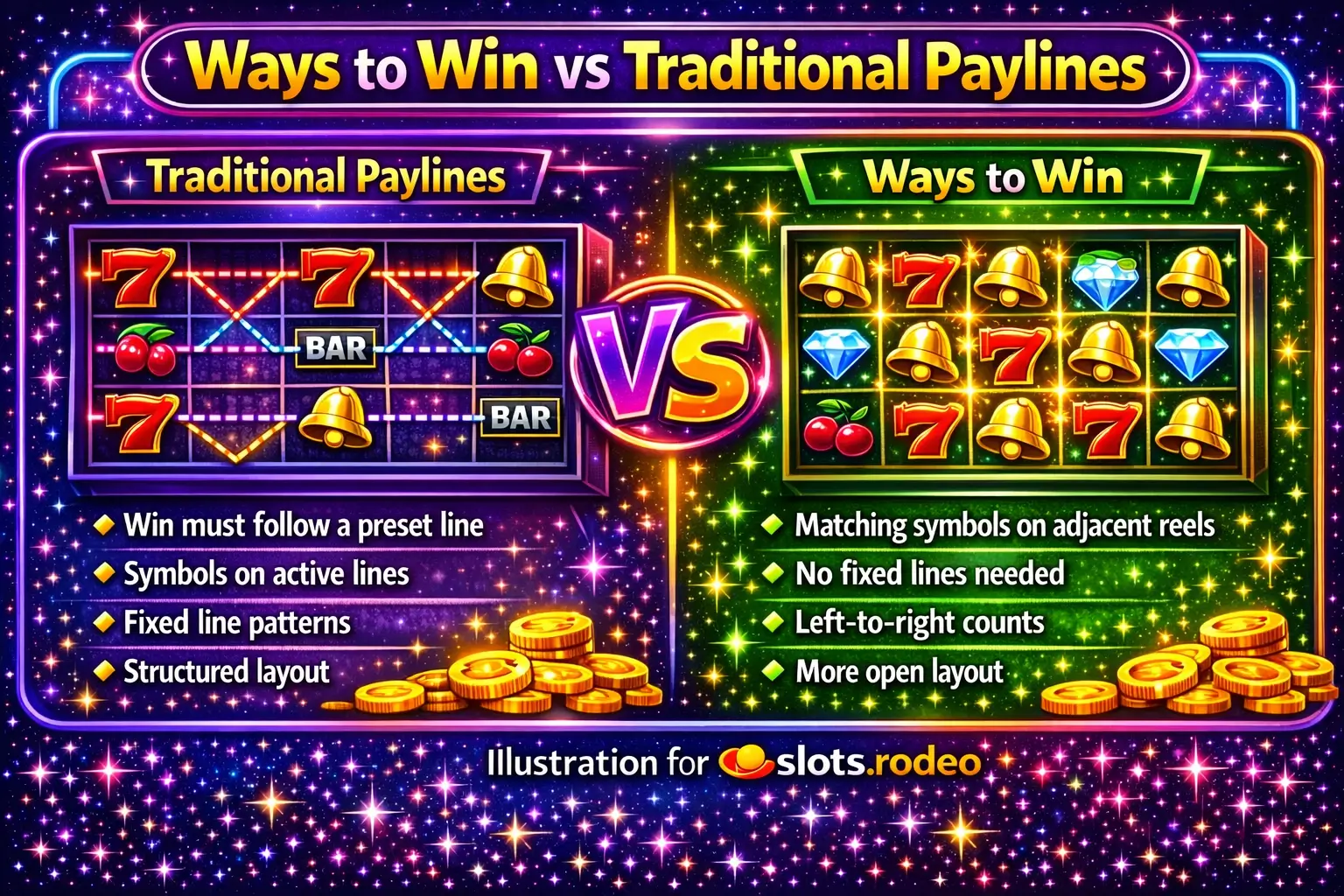
Caption: Traditional paylines use preset line paths; ways-to-win systems usually count matching symbols on adjacent reels instead of on fixed lines.
How a win is actually formed
In a payline game, a symbol combination only pays if it follows one of the listed paylines. If the same symbols appear on the reels but do not sit on an active line, that pattern does not count.
In a ways-to-win game, matching symbols usually need to appear on adjacent reels starting from the first reel on the left. A symbol on reel 1, reel 2, and reel 3 can form a win even if those symbols are on different row positions.
This is why ways-to-win slots often look more flexible: they are not restricted to a small set of fixed line routes.
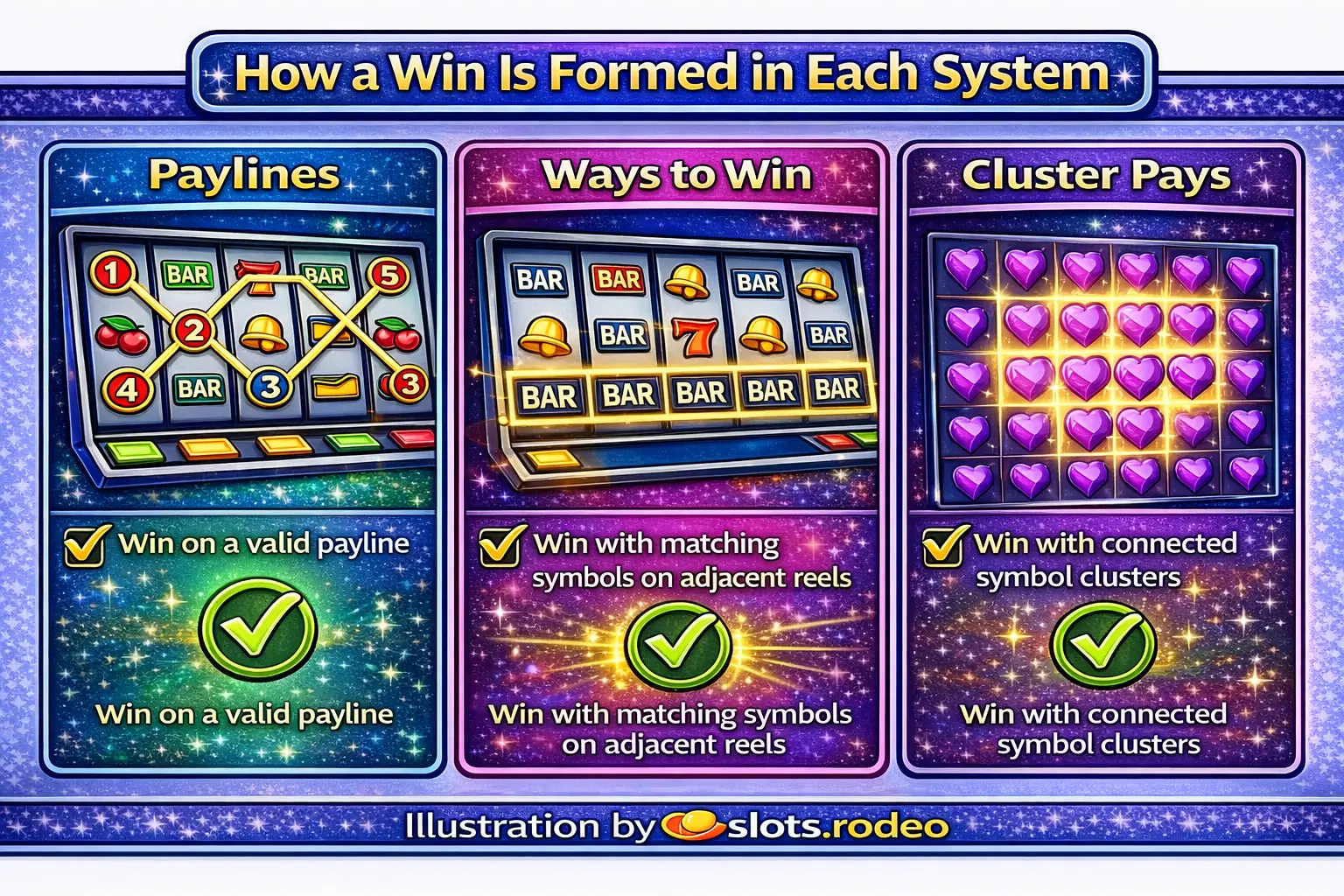
Caption: In a payline slot, symbols must follow a valid line pattern; in a ways-to-win slot, matching symbols usually need to appear on adjacent reels.
Side-by-side: what changes between the two
| Feature | Traditional Paylines | Ways to Win |
|---|---|---|
| How wins are checked | Against preset line patterns | Across adjacent reels |
| Does row position matter? | Yes, because it must match the payline | Often less, because any position on the reel may count |
| Typical direction | Usually left to right | Usually left to right |
| Can symbols on different rows combine? | Only if connected by a payline | Usually yes |
| What to check first | Number of paylines and whether they are fixed or adjustable | Total number of ways and the exact reel-count rule |
| Common source of confusion | Players assume any visible match pays | Players assume every visible cluster pays |
How wins are checked
Does row position matter?
Typical direction
Can symbols on different rows combine?
What to check first
Common source of confusion
Why ways-to-win slots often feel more open
The main reason is visual logic.
In a payline slot, you can see matching symbols on the screen and still get nothing because they are not connected by an active line. For beginners, this can feel counterintuitive until they understand that the line pattern is the real rule.
In a ways-to-win slot, the rule is usually easier to follow visually: matching symbols must continue from reel to reel. Because row position often matters less, more symbol arrangements can qualify.
That doesnotmean the game is automatically better or more generous. It only means thecounting methodis different.
What "ways" really means
In these games, the number of possible winning routes is usually shown as a total such as243 ways1,024 waysor another fixed value.
That number comes from the number of symbol positions on each reel. For example, in a simple 5-reel layout with 3 visible rows on every reel:
3 x 3 x 3 x 3 x 3 =243 ways
Each reel position can combine with matching symbols on adjacent reels, creating many possible routes without using named paylines.
Some games use a fixed number of ways. Others use variable reel heights, which means the number of ways can change from spin to spin. In both cases, the principle stays the same: the game counts matching symbols across neighboring reels rather than along fixed lines.
Where players misread the screen
In traditional payline slots
A player may see three matching symbols and assume that is enough. But if those symbols do not sit on the same active payline, the game will not count them as a win.
In ways-to-win slots
A player may see several matching symbols scattered around the grid and assume all of them combine. That is also wrong. In most cases, the symbols still need to be onadjacent reelsusually starting from the leftmost reel unless the rules say otherwise.
The screen can look busier in a ways-to-win slot, but the paytable still defines what counts.
The paytable matters more than the label
The label "ways to win" or "paylines" only tells you the basic counting method. It doesnottell you everything important.
Before playing, check these points in the paytable or help screen:
| What to check | Why it matters |
|---|---|
| Win direction | Some games pay left to right only; others may pay both ways |
| Minimum reels needed | Some symbols need 3 reels, others may need more |
| Wild behavior | Wilds may substitute in some systems, but not always for every symbol |
| Reel layout | Fixed rows and variable rows affect how often combinations appear |
| Line settings | In older payline slots, not all lines may be active by default |
| Bonus symbols | Scatters usually follow separate rules and may ignore paylines |
Win direction
Minimum reels needed
Wild behavior
Reel layout
Line settings
Bonus symbols
A lot of confusion comes from treating all reel symbols the same. They are not.Scatter symbols often work outside the main win systemwhile standard paying symbols must follow the game's main rules.
Which system is more straightforward for a novice to understand?
This depends on what the player finds more user-friendly.
Traditional paylinesoffer an easier experience when a clear, visible structure is desired. Players can see that the game checks specific lines, and the paytable typically illustrates these line shapes clearly.
Ways to winare simpler when you prefer a more straightforward rule: matching symbols on consecutive reels. Many beginners find this approach more intuitive since the game does not rely on zig-zag line patterns.
Nonetheless, neither method eliminates the necessity of understanding the rules. A slot may appear simple at first glance yet include exceptions for wild symbols, bonus symbols, expanding reels, or two-way wins.
One crucial aspect that doesnotchange
Regardless of whether a slot features paylines or ways to win, the system doesnoton its own indicate:
- the game's volatility
- the frequency of bonus occurrences
- the potential maximum wins
- whether the RTP version aligns with other versions
These are distinct inquiries. Win structure clarifieshow combinations are calculatednot whether the game is high-risk, low-risk, or suitable for a certain budget.
A visual breakdown of the main differences
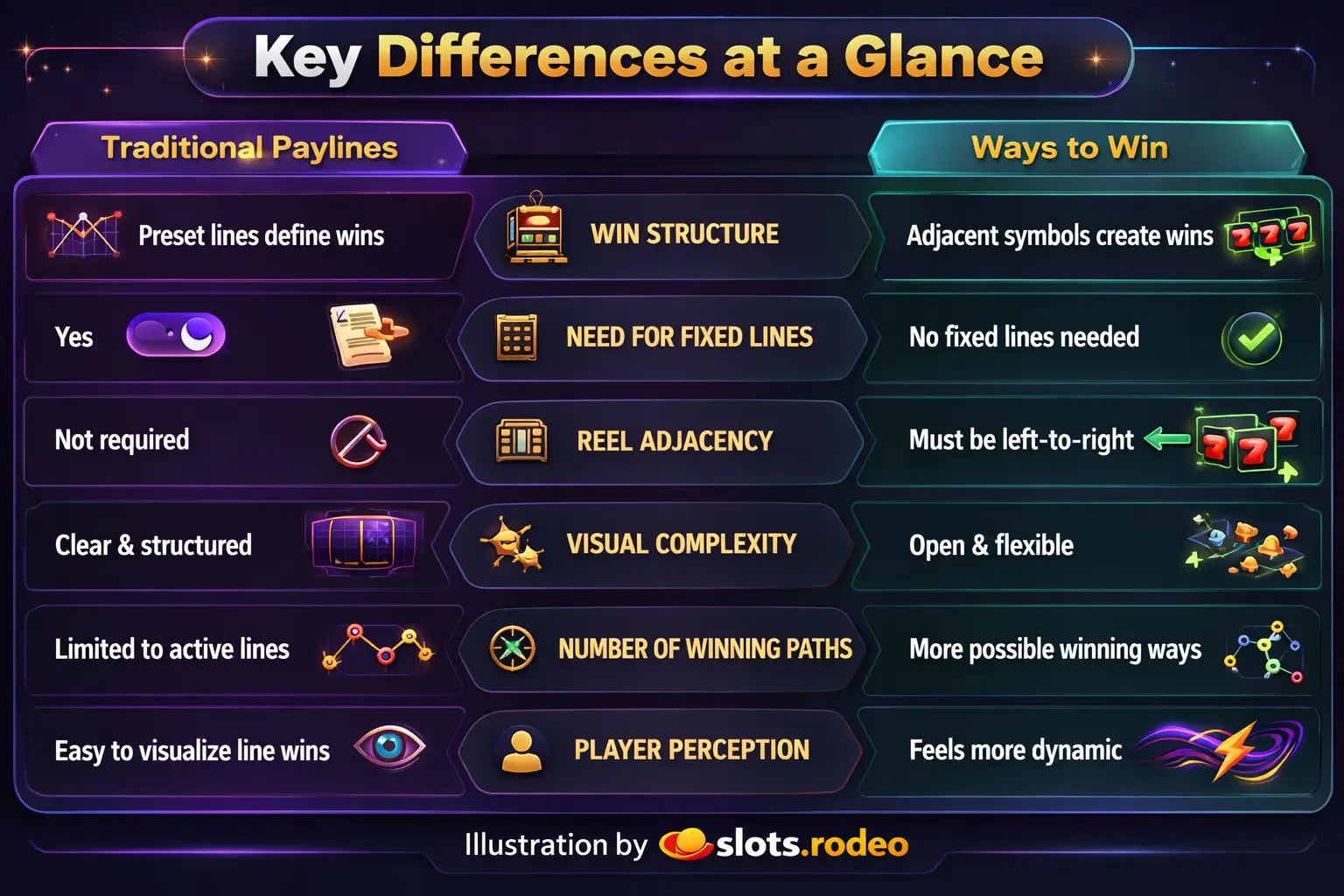
Caption: The primary distinction is straightforward: paylines adhere to predetermined line paths, while ways-to-win slots typically tally matching symbols across adjacent reels.
Key considerations before playing
If you launch a slot and are unclear about how wins are generated, avoid making assumptions based solely on the reel layout.
Check:
- whether the game employs fixed paylines or ways to win
- whether wins only pay from left to right
- how many reels are necessary for a standard symbol win
- whether scatter symbols follow different rules
- whether the reel setup remains fixed or changes during gameplay
That brief assessment typically clarifies most confusions before the first real-money spin.
FAQ
Frequently asked questions regarding this topic.
No. They use an alternative win-counting method, but that alone does not make them superior. The overall quality of the game relies on the complete rules, feature design, volatility, and paytable.
Generally yes, provided they are on adjacent reels and fulfill the game's reel-by-reel requirement. The precise conditions are outlined in the help section.
No. Many payline slots utilize diagonal or zig-zag patterns. A valid payline does not necessarily have to be linear.
Typically no. Scatter symbols often have distinct rules and can pay based on their count anywhere on the reels, though this varies by game.
Not automatically. A greater number of ways alters the possible reel-to-reel combinations, but it does not ensure improved session outcomes.
