

Understanding Expanding Wilds
Anexpanding wildis a wild symbol that extends beyond its initial position, encompassing a larger section of the reel layout.
In many slot games, this means one wild symbol can expand to cover an entire reel. In other instances, it may spread across a section of a reel, a row, or a specified area of the grid. The specific shape varies by slot design, but the underlying concept remains: the wild becomeslarger than a single symbol position.
This is significant because a more extensive wild area can create additional winning combinations compared to a typical single-position wild.
Distinguishing features of an expanding wild
A standard wild typically occupies a single symbol spot. It only contributes in that specific location. An expanding wild alters the layout more dramatically. Once it grows, it can impact multiple positions simultaneously.
This can significantly influence the reel outcome, particularly in games where a full reel of wilds can connect various paylines or numerous ways-to-win paths at once.
| Wild type | Usual size | Main effect |
|---|---|---|
| Standard wild | One symbol position | Substitutes in a single spot |
| Expanding wild | Multiple positions on a reel or area | Increases wild coverage |
| Sticky wild | One or more positions over time | Keeps wild coverage active across later spins |
Standard wild
Expanding wild
Sticky wild
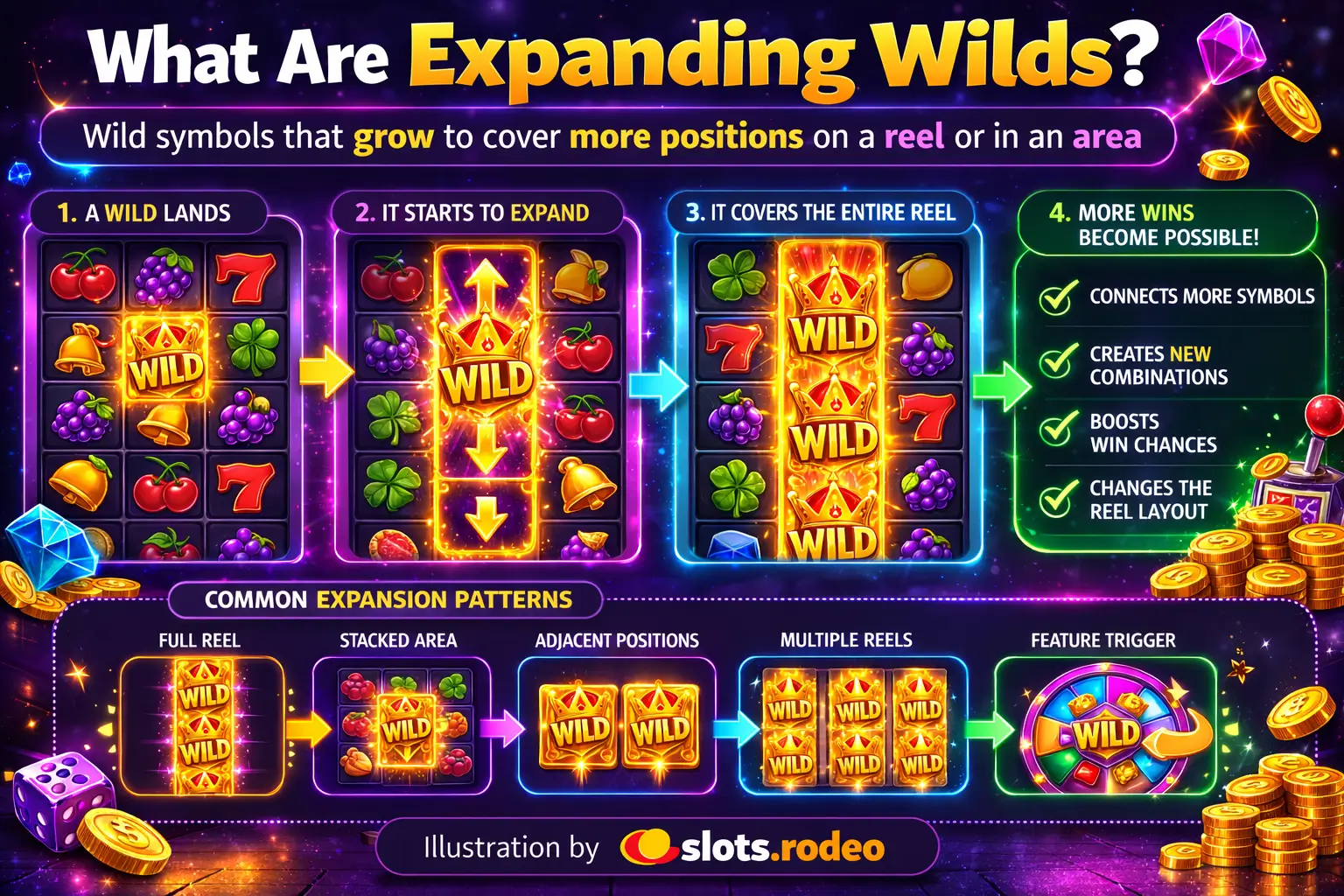
Mechanics of expanding wilds
The basic process is generally straightforward:
- A wild appears or is activated.
- The game implements an expansion rule.
- The wild extends across a reel, row, or another defined section.
- The final outcome is assessed with the expanded wild included.
In many traditional designs, the wild expands vertically to fill the entire reel. This is one of the most prevalent formats due to its clarity and strong visual impact.
However, not every slot adheres to the same framework. Some expanding wilds:
- expand solely during bonus rounds
- expand only on designated reels
- expand after the reels have stopped
- expand when a specific trigger condition is fulfilled
- expand into a section of a reel instead of the entire reel
The label indicates the general behavior, but not the complete set of rules.
The most prevalent type: full-reel expansion
A full-reel expanding wild is the variant that many players are most familiar with.
A single wild lands on a reel and then extends to occupy every position on that reel. For a 5x3 slot, this results in three wild positions on a single reel. In a taller configuration, it may stretch to cover four, five, or even more positions.
This is advantageous because a complete reel of wilds can facilitate multiple combinations simultaneously.
| Reel setup | What the expansion usually does |
|---|---|
| 5x3 slot | Wild may cover all 3 positions on one reel |
| 5x4 slot | Wild may cover all 4 positions on one reel |
| 6x5 grid | Wild may cover a full reel column if the game allows it |
5x3 slot
5x4 slot
6x5 grid
The specific value of that reel is determined by the slot's pay structure. In line-based games, it can link multiple paylines. In ways-to-win formats, it can support numerous symbol paths simultaneously.
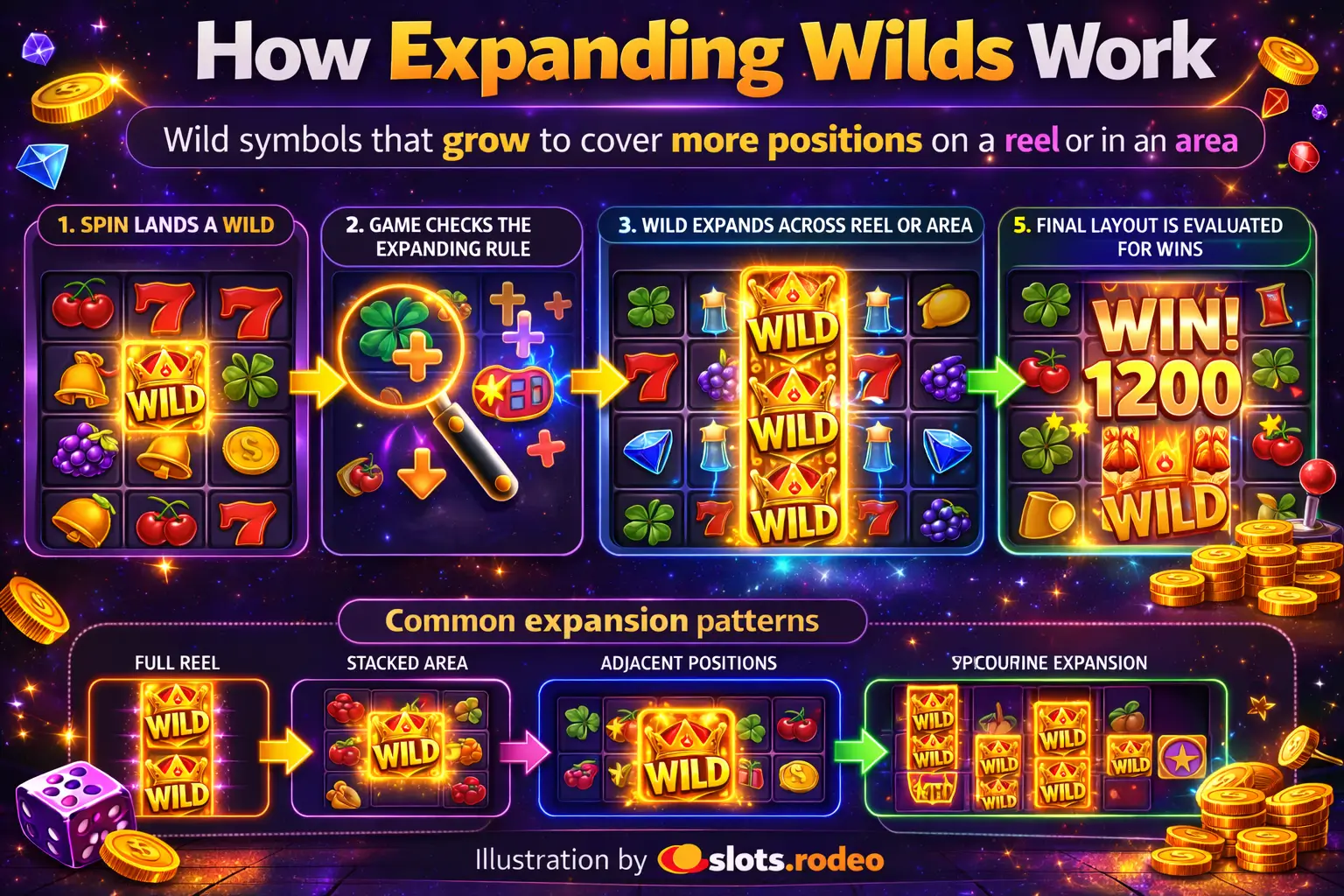
Typical locations for expanding wilds
Expanding wilds are utilized when the game aims for a single symbol event to transform the screen.
They frequently appear in:
- traditional-style video slots
- free spins features
- reel-centric bonus rounds
- wild-centric feature mechanics
- games that offer full-reel win potential
While they can also occur in the base game, many slots reserve the more potent expanding-wild behavior for bonus features.
Impact of expanding wilds on the reel layout
This is the primary reason the mechanic is significant.
An expanding wild alters the display from a conventional symbol arrangement to one withgreater substitution coverage. This can influence:
- the number of connecting paylines
- the number of open ways-to-win paths
- the number of positions that are effectively wild at a time
- the ease with which other symbols can form combinations
A standard wild impacts one position. An expanding wild can affect a whole section of the display.
Importance of this on paylines
On a payline slot, a full-reel expanding wild can sit across several line paths at once. That means one expansion can support more than one line combination in the same result.
Why that matters on ways-to-win systems
On a ways game, a reel with expanded wild coverage can act as a strong connector between adjacent reels. That can increase the number of possible winning paths built from the same screen.
Expanding wilds are not always full-reel wilds
That is a common assumption, but it is not always correct.
Some slots use:
- partial expanding wildsthat cover only part of a reel
- horizontal expansionsacross a row
- area expansionsin a defined block on the grid
- conditional expansionsthat happen only in a certain mode
- stacked-to-expanded transitionswhere a stacked wild becomes a full expansion
So when checking the rules, look for the exact wording. "Expanding wild" does not always mean "fills the whole reel."
Timing matters: when does the wild expand?
The mechanic can look similar across slots, but timing changes how it feels.
| Expansion timing | What it means |
|---|---|
| After the reels stop | Wild lands, then expands before payout evaluation |
| During a feature step | Expansion happens only in free spins or bonus mode |
| On trigger | Expansion begins when a condition is met |
| On selected reels only | Only certain reels can host the expansion |
After the reels stop
During a feature step
On trigger
On selected reels only
This is important because some games treat expansion as a standard wild behavior, while others treat it as a bonus effect.
Expanding wild vs sticky wild vs regular wild
These mechanics are often grouped together because they all involve wild symbols, but they work in different ways.
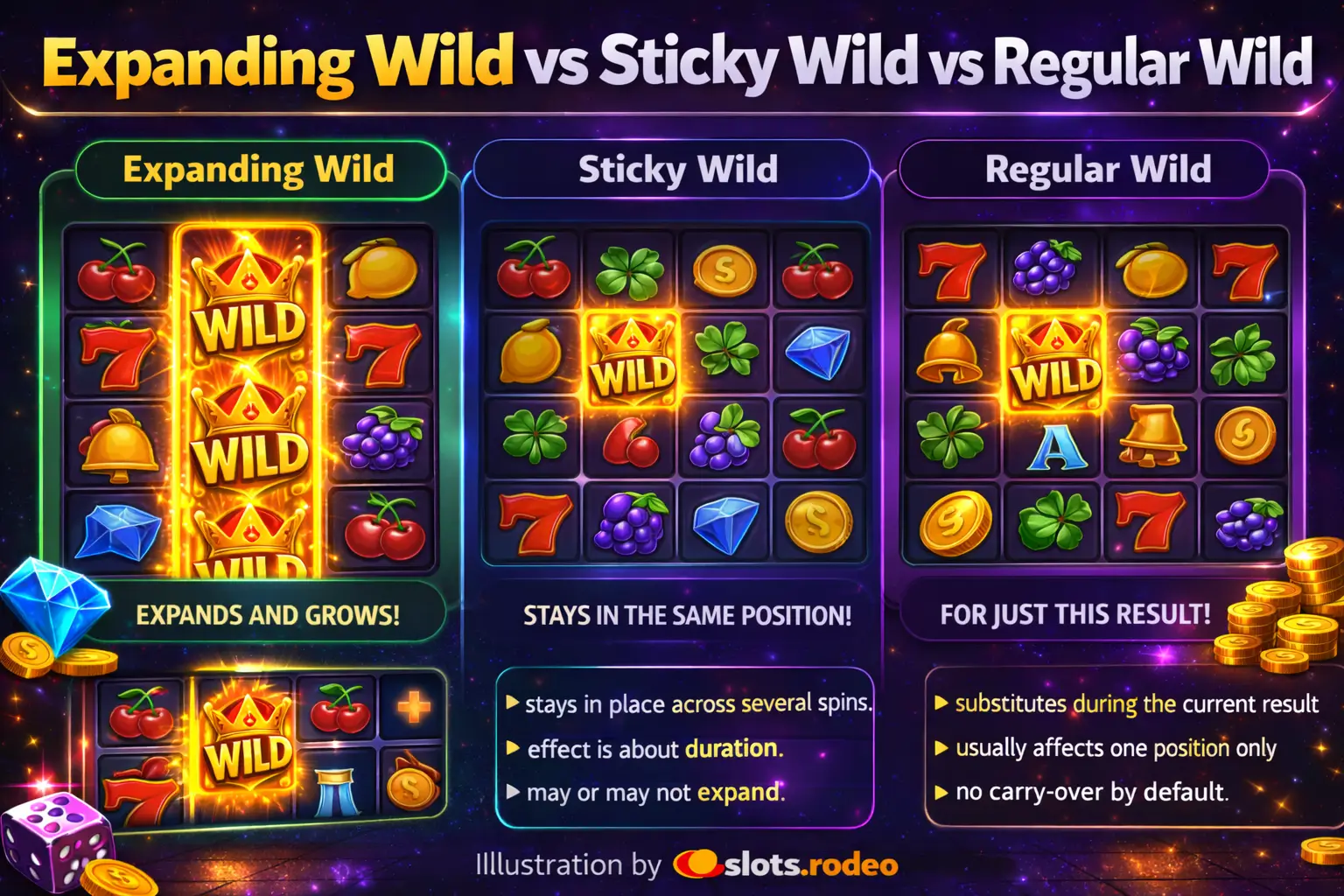
| Wild type | Main behavior | Main advantage | Usual duration |
|---|---|---|---|
| Regular wild | Substitutes in one position | Helps the current result | Usually one spin |
| Expanding wild | Grows across a reel or area | Covers more positions at once | Usually current result or feature step |
| Sticky wild | Remains in place for later reel actions | Affects future results too | Several spins or a feature round |
Regular wild
Expanding wild
Sticky wild
The simplest distinction is this:
- regular wild= one position
- expanding wild= more coverage
- sticky wild= more time
A slot can also combine them. For example, a wild may expand and then remain sticky during free spins.
Do expanding wilds guarantee bigger wins?
No.
An expanding wild increases wild coverage, but the payout still depends on what other symbols are present, how the game pays, and whether the expanded positions create valid combinations.
A few practical points:
- a full reel of wilds looks strong, but needs matching symbols on other reels
- on some paylines, the position still matters
- In certain slots, the presence of expanding wilds is frequent yet has minimal impact.
- In contrast, other titles link this feature to the game's most powerful states.
Thus, the mechanic indicatesthe influence of the layout.rather than assuring the quality of outcomes.
Key aspects to review in the paytable or help section
Before concluding that expanding wilds hold significant value, consider the following aspects:
| What to check | Why it matters |
|---|---|
| Which reels are designated for expanding wilds | Central reels and edge reels can affect wins differently |
| Whether the wild expands completely or partially | Defines actual screen coverage |
| If the expansion occurs in the base game, bonus feature, or both | Changes how often you may see it |
| Whether the wild can substitute for all standard symbols | Some games exclude scatter or bonus symbols |
| If the expanded wild brings additional effects | Multipliers or other modifiers can matter more than the expansion itself |
| Whether multiple expanding wilds can show up simultaneously | Multiple expanded reels can change the whole screen structure |
Which reels are designated for expanding wilds
Whether the wild expands completely or partially
If the expansion occurs in the base game, bonus feature, or both
Whether the wild can substitute for all standard symbols
If the expanded wild brings additional effects
Whether multiple expanding wilds can show up simultaneously
These specific rules are far more crucial than the animation alone.
A straightforward illustration
Picture a 5x3 slot where a wild appears on reel 3 and expands to occupy the entire reel.
- the wild initially appears in a single position.
- the reel extends to encompass three wild positions
- paylines that intersect reel 3 now connect with a wild in every row
- the ultimate outcome is assessed with that entire reel serving as wild coverage
In a ways-to-win slot, this expansion can facilitate multiple symbol combinations simultaneously. In a payline slot, it can assist in achieving several line wins from a single outcome.
Reasons for the frequent use of expanding wilds in slots
Expanding wilds are favored because they are visually straightforward and provide immediate feedback during gameplay.
Their effectiveness stems from:
- one symbol event having a noticeable effect
- the reel configuration is distinctly altered on the display
- the feature is easily comprehensible for newcomers
- full-reel coverage generates significant visual momentum
They represent a clear illustration of a mechanic that modifies the screen layout in a simple and understandable manner.
FAQ
Frequently asked questions regarding this subject.
No. While many do, some expand only across a portion of a reel, a row, or a specific area.
No. An expanding wild alters coverage size, whereas a sticky wild modifies duration. A symbol may occasionally perform both functions, but they are distinct mechanics.
Yes. Certain slots incorporate them in the base game, while others limit their use to free spins or bonus features.
Typically not, but it varies by game rules. The paytable clarifies which symbols the wild can substitute.
Not automatically. They can enhance the screen layout, but their true value relies on the pay system, symbol arrangement, and feature rules.
