

A winning combination in a slot refers to the arrangement of symbols that the game recognizes for a payout. The specific criteria depend on the slot's configuration.
In some games, a win may necessitate matching symbols along a payline from left to right, while in others, the same symbol might award a payout from anywhere on adjacent reels. In a cluster-pay format, symbols must be adjacent to each other rather than aligned on a line.
This is why two slots featuring similar symbols can still have vastly different methods for calculating wins.
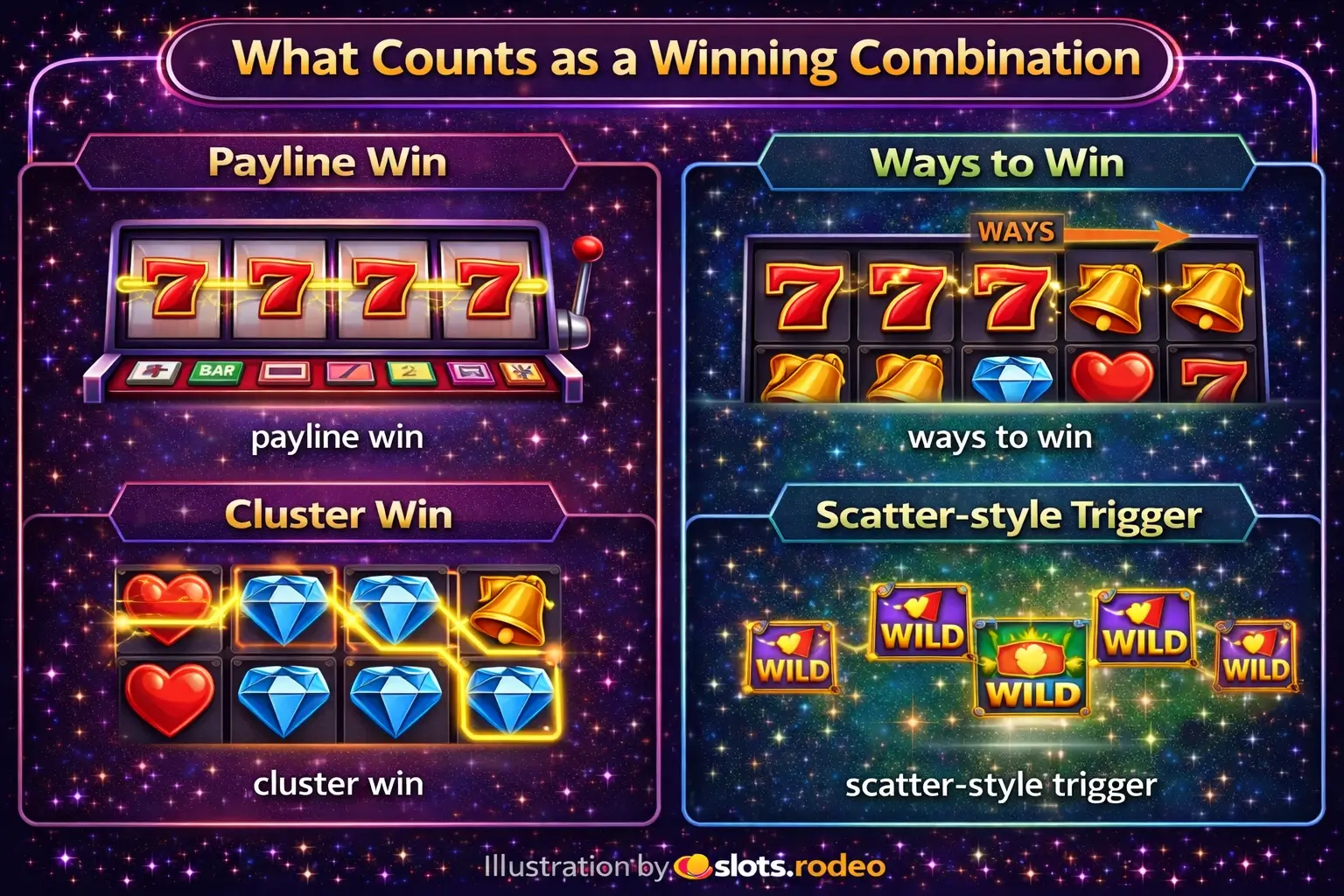
A slot only rewards combinations specified by its defined rules.
A slot does not provide payouts for any random assortment of matching symbols; it only rewards combinations that conform to the game's payout criteria.
Typically, this logic is determined by four key factors:
- the payout system utilized by the slot
- the minimum quantity of matching symbols needed
- the direction in which the combination must be formed
- whether special symbols like wilds can assist in completing the win
The paytable or help section outlines these regulations. To understand what constitutes a win in a particular slot, this should be your initial reference.
A winning combination does not always simply mean '3 matching symbols.'
Many newcomers assume that every slot operates like traditional 3-reel machines: align 3 symbols to receive a payout.
This is just one approach.
Contemporary slots may incorporate:
- fixed paylines
- variable paylines
- ways to win
- cluster pays
- all-ways systems like Megaways
- specific rules during bonus features
Thus, the critical question is not 'Did I match enough symbols?' but rather 'Did I match them in the manner that this slot recognizes?'
Understanding how winning combinations function across various slot formats
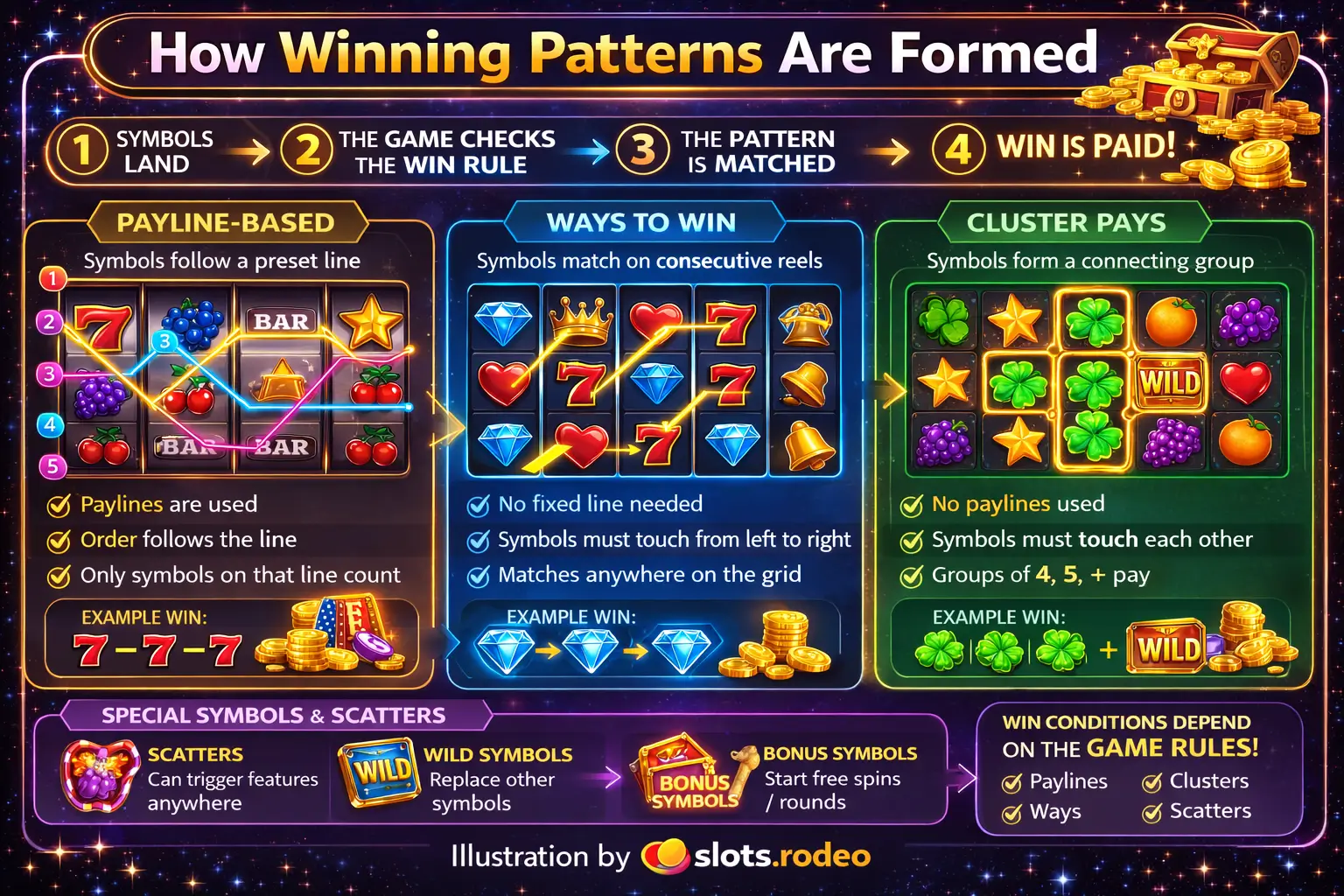
Payline slots: symbols must appear on a valid line
In a payline slot, symbols must land on a defined line pattern indicated by the game.
This line can be straight, zig-zag, V-shaped, or another predetermined configuration. A combination pays out only if the matching symbols align on one of the active paylines.
Most payline slots also stipulate that the combination should commence on the leftmost reel, unless specified otherwise by the game's rules allowing for payouts in both directions.
For instance:
- 3 matching symbols on payline 7 may yield a payout
- while the same 3 symbols in the same row might not pay if they don't occupy an active payline
- 4 matching symbols typically award more than 3.
- Four matching symbols typically yield less than five.
In this setup, the arrangement of lines is just as crucial as the symbol matches.
In ways-to-win slots, symbols need to appear on adjacent reels to create wins.
In ways-to-win formats, symbols aren't restricted to fixed paylines. Instead, they generally need to be adjacent from left to right.
For instance, in a 5-reel ways-to-win slot:
- the first reel displays a premium symbol in two spots
- the second reel shows the same symbol in three spots
- the third reel has that symbol in one spot
This results in2 x 3 x 1 = 6 winning combinationsfor a match on three reels.
This explains why a single spin in a ways-to-win slot can yield multiple combinations simultaneously. The game recognizes every valid path across consecutive reels.
In cluster-pay slots, symbols must connect with each other.
For cluster-pay slots, symbols generally do not need specific paylines or to align reel by reel. A win occurs when a minimum number of matching symbols are adjacent either horizontally or vertically. Some games also consider diagonal connections, if specified in the rules.
A cluster slot may require:
- four adjacent matching symbols
- five adjacent matching symbols
- nine or more adjacent matching symbols
The specific requirement varies by game.
In this setup, the primary consideration is the connection, rather than the line arrangement.
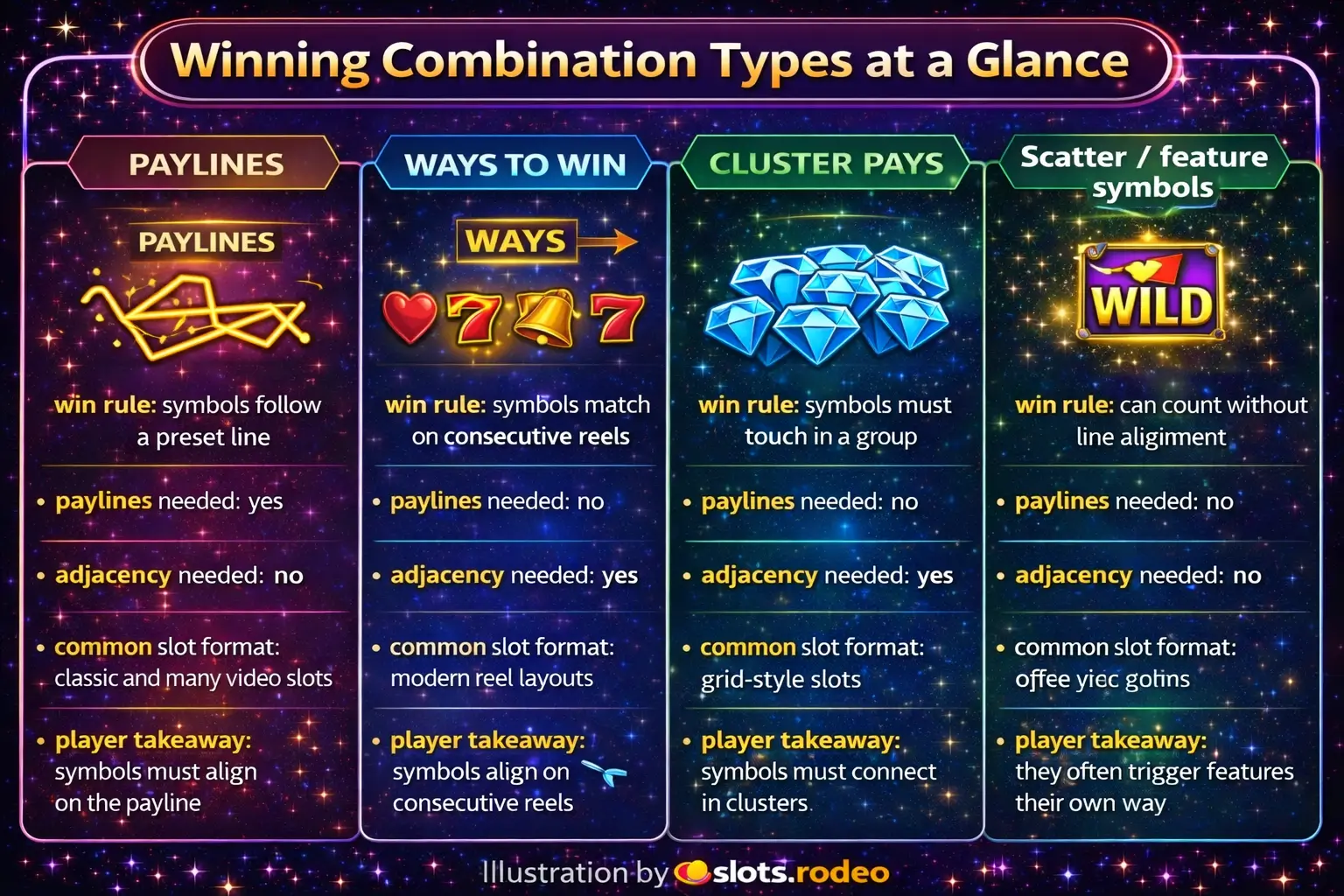
How win formation varies by slot type
| Slot format | What forms the win | Usual starting rule | What matters most |
|---|---|---|---|
| Paylines | Matching symbols on a defined payline | Often left to right | Line pattern |
| Ways to win | Matching symbols on adjacent reels | Usually left to right | Reel-to-reel continuity |
| Cluster pays | Matching connected symbols | No line start needed | Symbol contact |
Paylines
Ways to win
Cluster pays
What typically determines if the combination yields a payout
Minimum match requirement
Each slot defines a minimum number of matching symbols needed to trigger a payout.
Typical instances include:
- low-value symbols might pay out from 3
- premium symbols could pay out from 3
- certain high-value symbols may only pay from 4
- clusters might necessitate 4, 5, or more connected symbols
Do not presume all symbols share the same criteria.
Position criteria
A symbol match may still be invalid if it occurs in an incorrect location.
Standard position criteria consist of:
- must commence from the leftmost reel
- must land on an active payline
- must appear on consecutive reels
- must be grouped in a cluster
- may pay from both left-to-right and right-to-left in some games
This is a frequent reason players believe they should have received a payout when the slot does not show one.
Active gameplay mode
Certain slots modify win formation rules during free spins, respins, or bonus rounds.
Examples:
- additional paylines might be activated
- wild symbols may occur more often
- symbol sizes may vary in Megaways slots
- clusters might cascade and generate new wins from a single paid outcome
A combination that is infrequent in the base game may be easier to achieve during a feature.
The role of wild symbols in a winning combination
Wilds generally assist in completing winning combinations, but their function differs across slots.
A wild may:
- act as substitutes for standard paying symbols
- fail to act as substitutes for scatter or bonus symbols
- function only on specific reels
- expand, remain in place, or shift during special features
This is significant because a formation that appears to be a win might not yield a payout if the wild cannot stand in for the absent symbol according to that game's rules.
Understanding why a seemingly correct pattern may not result in a payout
Players frequently observe matching symbols on the screen and think the game overlooked a payout. Generally, the problem lies in one of the following:
| Common reason | Why it does not pay |
|---|---|
| Symbols are not aligned on an active payline | Payline slots only pay listed line paths |
| Match does not initiate in the necessary position | Many games require leftmost-reel start |
| Symbols are not situated on adjacent reels | Ways systems usually need adjacent reels |
| Connected symbols fail to satisfy the cluster requirement | The group may be too small or not connected correctly |
| Wild does not act as a substitute in that scenario | Some symbols cannot be replaced by wilds |
Symbols are not aligned on an active payline
Match does not initiate in the necessary position
Symbols are not situated on adjacent reels
Connected symbols do not fulfill the cluster requirement
Wild does not act as a substitute in that scenario
What to verify in the paytable before making assumptions about a win
Before concluding whether a slot paid out correctly or incorrectly, review these aspects in the paytable:
- Pay systempaylines, ways, or clusters
- Minimum symbol quantitynumber of matching symbols required
- Direction rulesleft to right, both directions, or no specific direction rule
- Wild behaviorwhat wilds can and cannot substitute for
- Rules for special featureswhether the bonus round alters win structures
These five checks clarify most payout inquiries.
Winning combination versus total payout
A winning combination refers solely to the pattern eligible for a payout, but it does not indicate the final payout amount by itself.
The actual payout is also influenced by:
- the value of the symbols
- the quantity of matching symbols present
- the size of your bet
- the number of ways or paylines involved
- whether multiple wins are combined in a single spin
Thus, there are two distinct queries:
- Was a valid winning combination created?
- What is the value of that combination?
Players should distinguish between these two concepts. The first pertains to game mechanics, while the second concerns payout computation.
Common errors made by newcomers
Several misconceptions frequently arise:
"Matching symbols anywhere guarantee a payout"
This is incorrect. A slot only rewards combinations that conform to its specific rules.
"If 3 symbols yield a payout, then any 3 of that symbol should pay"
This is false. They may need to appear on a payline, on consecutive reels, or in a connected cluster.
"Wild symbols always complete the combination"
This is not accurate. Wilds frequently come with limitations.
"If the symbols are close enough, the slot should acknowledge it"
This is incorrect. Slot mechanics are precise. Near-misses do not count unless they adhere to the established rules.
FAQ
Frequently asked questions regarding this subject.
No. Some slots pay for 2 symbols, many require 3, and cluster games may demand 4, 5, or even more connected symbols.
Yes. The outcome is determined by the payout system and the rules outlined in the paytable.
No. Numerous slots follow left-to-right payout rules, but some pay in both directions, and cluster games typically do not utilize a left-start rule.
No. Many wilds can substitute for regular symbols, but they often do not replace scatters, bonus symbols, or other specialized symbols.
Refer to the paytable for the payout system, minimum matching count, direction rules, and wild symbol restrictions. These four aspects usually clarify how the game determines what constitutes a winning combination.
