

When an online casino claims to be licensed, don’t take it at face value based solely on a badge or text in the footer.
A thorough license verification involves more than just spotting a regulatory name on the site; it requires checking if the claim is clear, consistent, and can be validated.
This is crucial as many casino websites present licensing in a non-specific manner. Some provide an actual license number, while others only name a regulator. Some use outdated or ambiguous terms, and many make claims that are difficult to substantiate.
The effective strategy is straightforward: begin by examining the casino's own disclosures, then verify if that information can be corroborated.
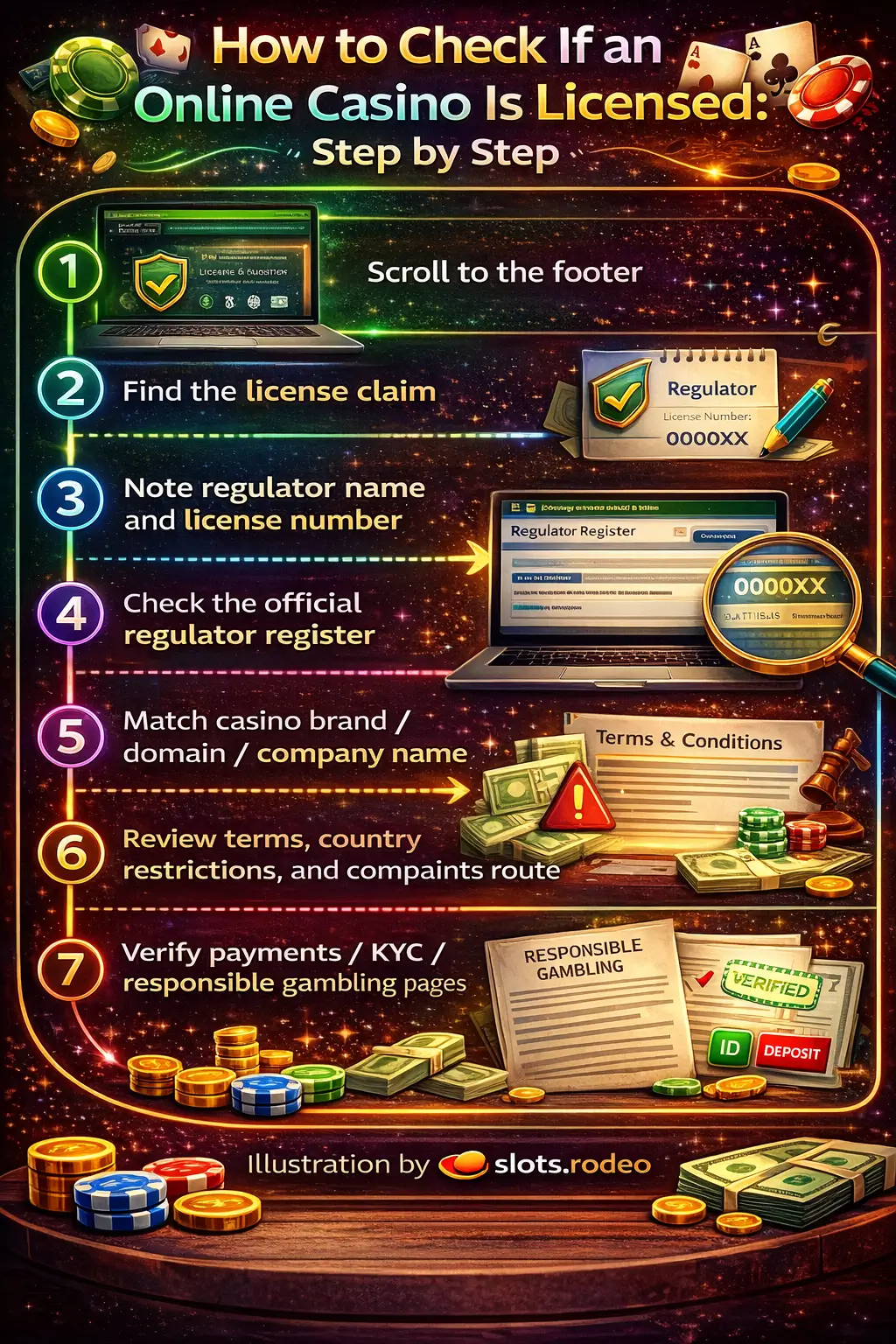
The Importance of Conducting a License Check
A license is one of the primary indicators of trustworthiness to assess when considering an online casino.
It aids in addressing fundamental inquiries such as:
- who oversees the operator
- which legal entity manages the casino
- if the site provides official company information
- if there is an identified jurisdiction
- if there are structured rules for disputes, compliance, and operations
However, a license check is merely one aspect of a casino evaluation. While it holds significance, it doesn’t provide insights into payout speeds, the quality of customer service, or the site's complaint resolution practices.
Step 1: Start with the footer
Typically, the footer is the initial location where a casino displays its licensing information.
Look for:
- regulatory body name
- license identifier
- business name
- registered office address
- operating entity designation
- jurisdiction
- links to Terms and Conditions, Privacy Policy, or Responsible Gambling information
A trustworthy footer tends to present detailed information rather than just a logo or a vague statement.
Stronger example
"Managed by Example Gaming N.V., licensed under number 12345/JAZ."
Weaker example
"Completely licensed and secure."
The latter statement lacks specificity on its own.
Step 2: Review the Terms and Conditions or other legal documents
Do not depend solely on the information provided in the homepage footer.
Access pages like:
- Terms & Conditions
- About Us
- Responsible Gaming
- Privacy Statement
- AML/KYC Policy
- Contact Information
These sections typically indicate whether the licensing information is consistently presented.
Verify if the site provides the same:
- business name
- license ID
- regulatory authority
- operating jurisdiction
- legal terminology
Discrepancies between the footer and the legal pages can be a red flag.
Step 3: Determine the precise operator name
The casino brand name may differ from the legal operating name.
For instance:
- brand: Lucky Spin Casino
- operator: Example Gaming N.V.
This differentiation is important since the license typically belongs to the legal entity rather than the promotional brand.
A thorough verification should always seek:
- complete business name
- operating company
- jurisdiction
- how the site outlines the connection between brand and operator
If the operator is obscured or difficult to pinpoint, it undermines trust.
Step 4: Seek a specific license ID
A legitimate licensing statement should generally contain a unique number or registration identifier.
This serves as one of the most fundamental validations.
| What the site shows | What it means |
|---|---|
| Regulatory authority + precise license ID | Stronger starting point |
| Regulatory authority alone | Incomplete |
| "Licensed casino" without specifics | Weak claim |
| License badge without textual information | Weak on its own |
Regulatory authority + precise license ID
Regulator designation only
"Licensed casino" lacking specifics
Badge icon without textual details
A license number alone does not guarantee everything, but it is significantly better than a vague assertion lacking identifying information.
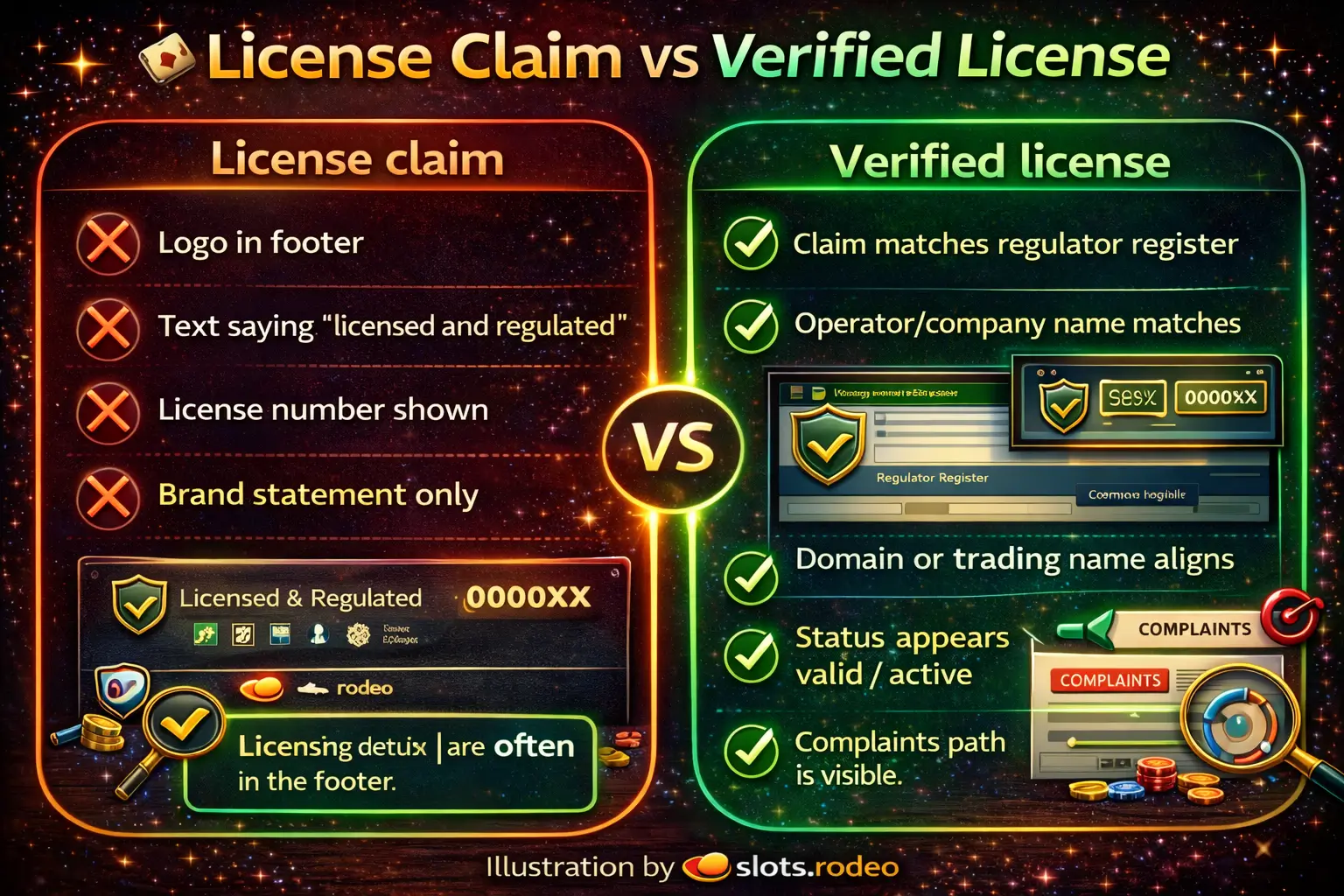
Step 5: Differentiate between a license assertion and a confirmed license
This aspect is crucial in the evaluation process.
A casino website canclaimclaim to be licensed. However, this does not equate to a license being distinctly verified.
A fundamental distinction appears as follows:
| Type | What it looks like |
|---|---|
| License assertion | The site says it is licensed |
| Confirmed license | The site gives enough exact information to check the claim against official or regulator-linked data |
License assertion
Confirmed license
A footer declaration alone constitutes a claim.
A statement containing:
- operator designation
- jurisdiction
- license identification number
- consistent legal terminology
- verifiable information
is significantly more robust.
Step 6: Assess if the language is specific or ambiguous
The language used is important.
More precise language often encompasses:
- operator designation
- license identification number
- name of the regulatory body
- phrase indicating legal entity
- regulatory jurisdiction
Less comprehensive phrases often consist of:
- "licensed and secure"
- "completely regulated"
- "globally certified"
- claims featuring only logos without detailed context
Marketing language does not equate to verification.
A review focused on trust should favor precise legal information instead of vague reassurances.
Step 7: Verify that the licensing information is consistent with the rest of the website
A licensing statement should align with the overall legal representation of the casino.
Investigate if the site additionally offers:
- detailed Terms and Conditions
- explicit KYC / verification guidelines
- section on responsible gambling practices
- avenue for complaints or contact
- restrictions based on jurisdiction
- details about payment procedures
- rules concerning withdrawals
A site that asserts it is licensed but lacks robust legal pages is more concerning than one with comprehensive legal documentation.
Step 8: Be alert for inconsistencies
Consistency checks are among the most valuable assessments.
Identify inconsistencies such as:
- a different company name in the footer versus the Terms
- one jurisdiction listed in the footer, none in the legal sections
- outdated licensing information replicated across pages
- non-functional links to legal documents
- licensing emblem without accompanying text
- ambiguous language regarding the operator
These do not definitively indicate a false license, but they do undermine trust.
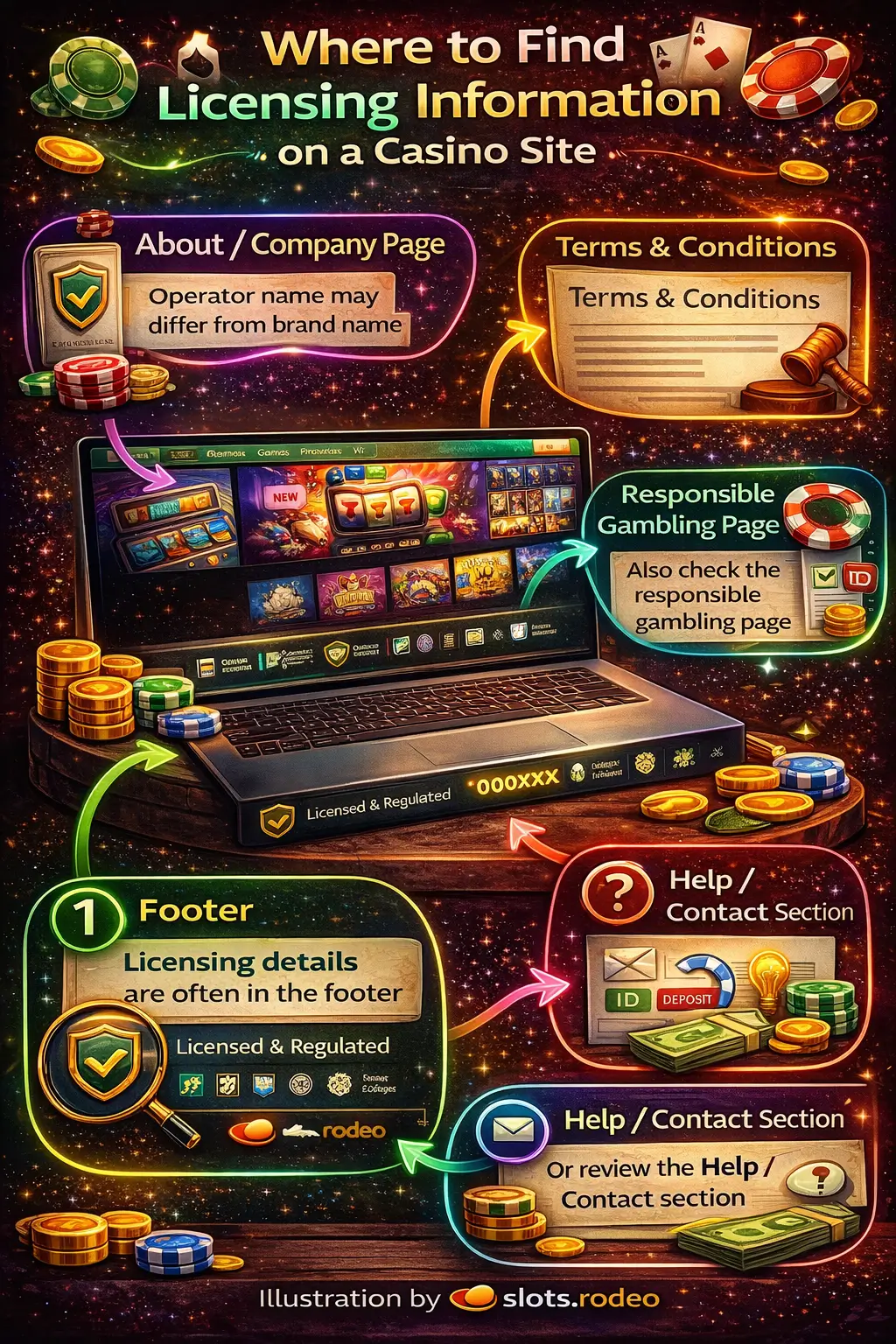
Where to locate licensing details on a casino website
The most frequently found locations are:
| Site area | What you may find there |
|---|---|
| Footer | Regulator, operator, license number, company details |
| Terms and Conditions | Legal entity, jurisdiction, operational wording |
| About Us | Corporate overview, sometimes simplified operator info |
| Page dedicated to Responsible Gambling | Regulator references, complaint guidance |
| Page for Contact Information | Company address or support jurisdiction clues |
| Page for Registration | Country restrictions or jurisdiction wording |
Footer
Terms and Conditions of Use
About Us
Page dedicated to Responsible Gambling
Page for Contact Information
Page for Registration
If the only mention of licensing is in a graphic banner or promotional area, it is insufficient.
Claim of license versus verified license
A practical guideline is as follows:
A claim states "we hold a license."
A verified assertion states "here is the operator's name, the jurisdiction, and the license reference."
This distinction is practical rather than theoretical.
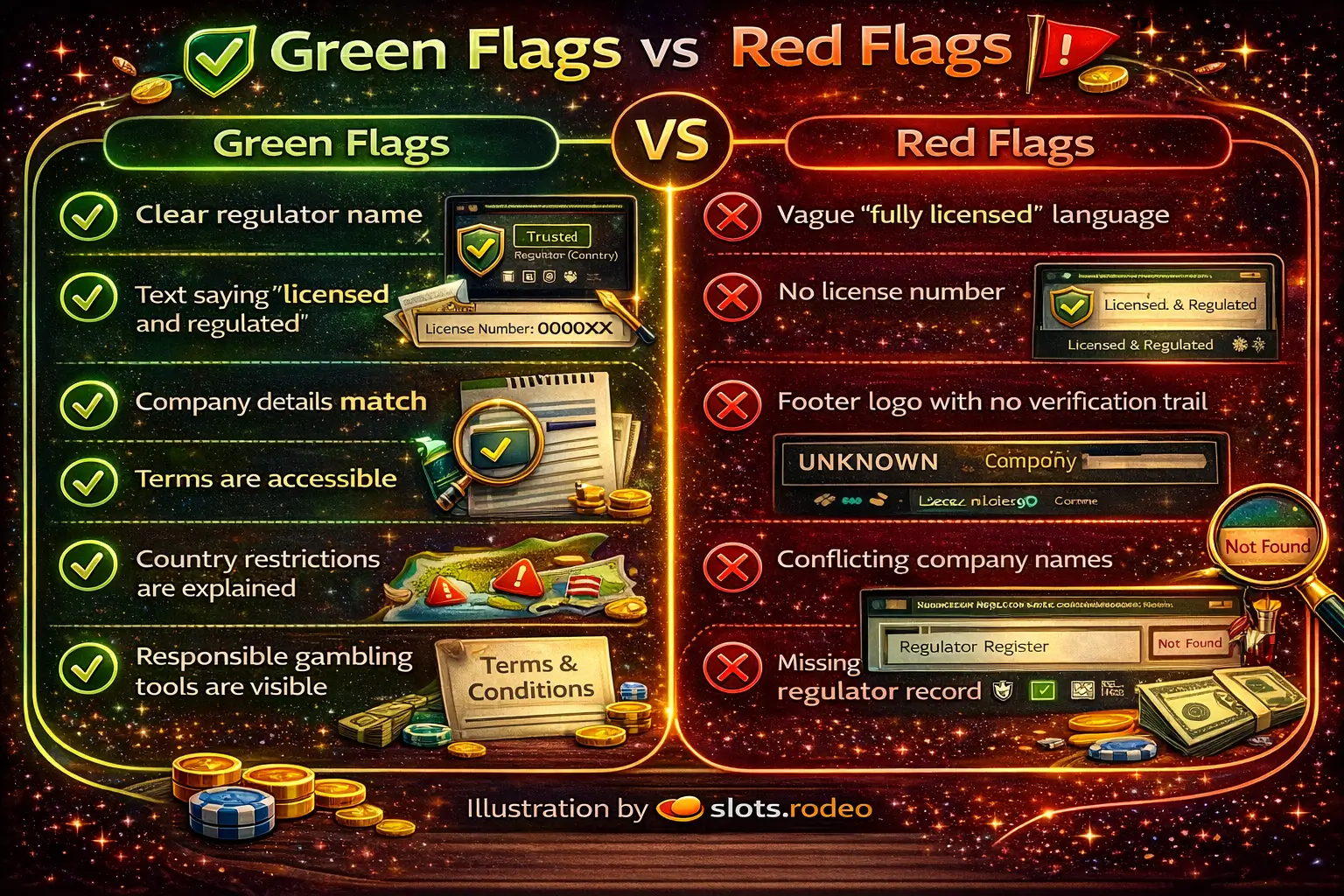
Indicators to consider positively
Certain indicators enhance the credibility of a licensing claim.
Green flags
- the full name of the operator is displayed
- the license number is provided
- the regulator's name is clearly stated
- legal documents consistently repeat the same information
- country limitations are clarified
- terms and rules for complaints are easily accessible
- a section on responsible gambling is present
- the platform utilizes precise legal terminology instead of solely promotional language
While these indicators do not guarantee the casino excels in all aspects, they do lend credence to the licensing assertion.
Warning signs to be aware of
Certain indicators should prompt increased vigilance.
Red flags
- absence of an operator name
- lack of a license number
- merely a badge image without accompanying specifics
- ambiguous "licensed and secure" phrasing
- discrepancies in company names across different sections
- non-functional or absent legal documentation
- no information regarding country restrictions
- lack of a clearly defined legal entity associated with the brand
- plagiarized or poorly crafted footer text that appears incomplete
While these issues do not always indicate an unlicensed site, they diminish trust.
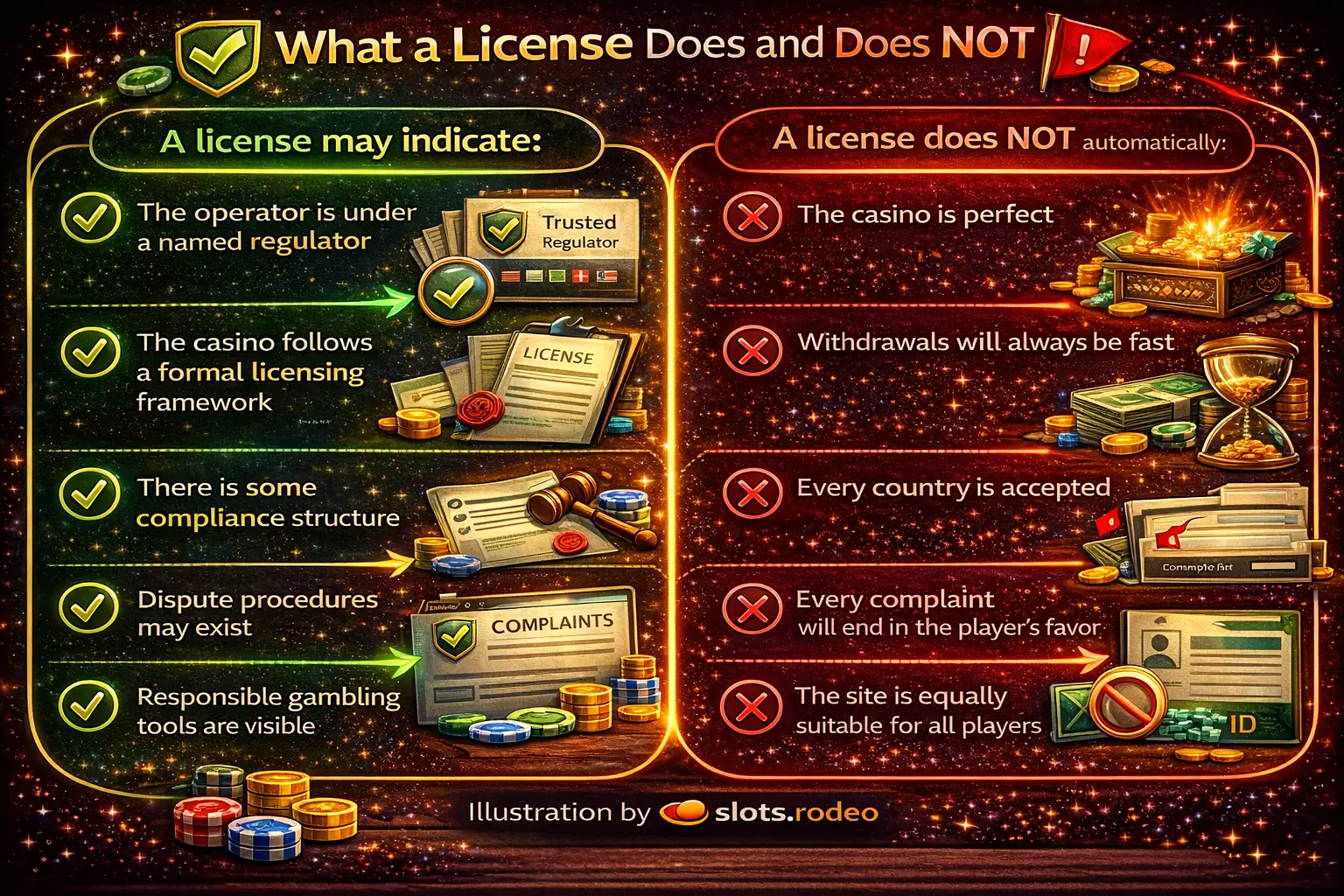
While having a license is significant, it does not encompass the entirety of the review.
A common error is to consider the term "licensed" as a conclusive factor.
This perspective is overly simplistic.
A license can indicate that the site operates within an established legal framework, but it doesnotnot necessarily reveal:
- the speed at which withdrawals are processed
- the responsiveness of support during disputes
- the stringency of KYC checks in real scenarios
- the fairness of bonus terms
- the user-friendliness of the casino
- the effectiveness of the complaint resolution process in all instances
This underscores the necessity for licensing to be one aspect of the review, rather than the sole focus.
Understanding the implications of a license
| A license may help show | A license does not automatically prove |
|---|---|
| An operator is clearly identified | Fast withdrawals |
| A legal jurisdiction is specified | Good customer support |
| The site offers official legal information | Fair bonus value |
| The casino adheres to certain regulatory guidelines | Smooth complaint handling in every case |
| The operator is presenting itself in a verifiable manner | High overall product quality |
An operator is clearly identified
There is an established legal jurisdiction
The website includes official legal information
The casino adheres to certain regulatory frameworks
The operator presents itself in a transparent manner
An easy step-by-step process
Follow this order for a straightforward procedure:
- examine the footer
- record the operator's name
- record the regulator's name
- record the license number
- access the Terms and Conditions
- verify that the same legal details are present
- determine whether the language is clear or ambiguous
- check for any country restrictions and legal consistency
- distinguish the license claim from actual verifiable information
This provides a solid initial verification check.
Frequent novice errors
Relying solely on the logo
A regulator's logo or badge is insufficient without accompanying text details.
Mistaking the brand name for the operator's name
The brand could differ from the legally licensed entity.
Only looking at the homepage footer
The legal pages are equally significant.
Considering "licensed" as an indicator of overall quality
While licensing is crucial, it does not address every trust-related concern.
Ignoring contradictions between pages
Inconsistency is one of the strongest warning signs.
What to check before calling a casino "licensed"
Before making that judgment, make sure you can answer these questions:
| Question | Why it matters |
|---|---|
| Who operates the casino? | The license belongs to the operator, not just the brand |
| Which jurisdiction is named? | Shows where the license claim is based |
| Is there an exact license number? | Stronger than a vague claim |
| Do legal pages match the footer? | Consistency is a core trust signal |
| Are legal and responsible gambling pages present? | Supports the seriousness of the legal setup |
| Is the claim precise enough to verify? | This is the real dividing line |
Who operates the casino?
Which jurisdiction is named?
Is there an exact license number?
Do legal pages match the footer?
Are legal and responsible gambling pages present?
Is the claim precise enough to verify?
FAQ
Common questions about this topic.
It is weak if the site uses vague wording, shows no operator name, or gives no specific license number.
No. The footer is the starting point. You should also check legal pages and consistency across the site.
Because the license usually belongs to the legal company operating the casino, not just the brand name.
No. A license is an important trust signal, but it does not automatically guarantee strong support, fast withdrawals, or fair bonus use.
One of the biggest red flags is vague licensing language with no exact operator details or no clear license number.
